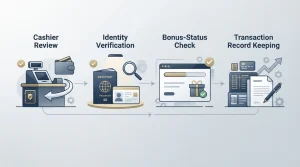


UK-licensed casinos cannot take credit-card gambling deposits; card branding alone does not show whether a payment is allowed.
Can a Credit Card Be Used for Online Gambling in the UK?
No. A UK-licensed online casino cannot accept credit-card payments for gambling. That applies whether the deposit is intended for table games, casino games generally or slots. A credit card may carry the Visa or Mastercard name, but that does not make it an eligible way to fund a gambling account.
The distinction that matters is the source of the money, not simply the logo on the card. Credit cards involve borrowing from the card issuer; debit cards draw on money held in a bank account. UK casinos commonly accept debit cards, including Visa and Mastercard, but that does not mean they accept the credit-card versions of those products for gambling.
This is where the cashier can look confusing. A page may use broad wording such as “card payments” or display a familiar card brand. Neither phrase, on its own, establishes that credit-card gambling deposits are permitted. The payment route and the product behind the card are separate things. A debit card bearing a familiar logo can be accepted while a credit card from the same brand cannot.
Credit card options and payment rules can change, so check the available methods before signing up. This list offers a starting point for reviewing casino sites relevant to UK players in 2026.
1. Zombillion
Payout speed: 1-3 business days
Zombillion lists a payout speed of 1–3 business days.
2. SlotoSport
Payout speed: 1-3 business days
SlotoSport lists a payout speed of 1–3 business days.
3. Dieselwin
Payout speed: 1-3 business days
Dieselwin lists a payout speed of 1–3 business days.
4. WinBeast
Payout speed: 1-3 business days
WinBeast lists a payout speed of 1–3 business days.
5. Britsino
Payout speed: 1-3 business days
Britsino lists a payout speed of 1–3 business days.
6. Revery Play
Payout speed: 1-3 business days
Revery Play lists a payout speed of 1–3 business days.
7. NightLuck
Payout speed: 1-3 business days
NightLuck lists a payout speed of 1–3 business days.
8. NightWin
Payout speed: 1-3 business days
NightWin lists a payout speed of 1–3 business days.
9. BeOnBet
Payout speed: 1-3 business days
BeOnBet lists a payout speed of 1–3 business days.
10. Chanze
Payout speed: 1-3 business days
Chanze lists a payout speed of 1–3 business days.
From behind the counter, that distinction is not a minor technicality. A deposit is a transaction the operator must be able to classify and process under its rules. If the funding source is a credit card, a UK-licensed casino cannot treat it as an ordinary card deposit simply because the transaction passes through a card network. The rule is about credit-card payments for gambling, not about whether the cashier has a general card button.
The restriction is not a temporary operator preference. The regulator’s ban remains in force, so a UK-licensed casino cannot make an exception for a particular customer or game. A claim that a site accepts credit cards for gambling should therefore be treated cautiously if it is presented as an option at a UK-licensed casino.
That does not mean every card deposit is unavailable. Debit cards are a distinct payment route and are commonly offered by UK casinos. But “card” is too broad a label to settle the question. The card product must be eligible, and the payment option shown for an account must match the route being used. A credit card should not be used to fund casino play.
The same answer applies to online slots. A slot deposit is still a gambling deposit; changing the game does not change the payment rule. There is no separate credit-card allowance for slots, and the fact that a casino offers slots does not alter which card products it may accept for gambling.
UK Casino Sites That Accept Jeton: What to Check
Other ways of funding an account are not automatically equivalent to a credit card. A bank-based route or a permitted payment service may have its own conditions, while debit cards remain distinct from credit cards. The important point at this stage is simple: a different payment method is not a credit-card deposit merely because it moves money into the same casino balance. Its own eligibility has to be assessed on its own terms.
For a practical decision, the useful question is not whether a casino “takes cards” in general. It is whether the specific payment product is a debit card or another permitted route, rather than a credit card being used to fund gambling. General wording can blur that line. The underlying source of funds does not.
What “Credit Card Casino” Listings Actually Mean in 2026
A casino page displaying Visa or Mastercard does not, by itself, show that credit-card deposits are available. The names identify card networks, not the kind of card the cashier will accept. A logo can cover debit-card payments, while a headline or comparison table may leave that distinction unstated.
That gap matters in Britain. Remote gambling licensees cannot accept credit-card payments for gambling, so a UK-facing listing that groups all card payments together is not evidence of a lawful credit-card route. The practical detail is narrower: which payment option appears in the casino cashier, and which card products are eligible under that option. Brand recognition is not enough.
I have seen payment pages written to make a broad method sound like a simple promise. “Visa accepted” may mean Visa debit, not Visa credit. The same distinction applies to Mastercard. A brand name in a footer, a general payments page or a review table can describe the network without specifying the card type. Read the wording as a label, not a guarantee.
Attention: A logo for Visa or Mastercard does not guarantee that credit cards are accepted; it may only refer to debit cards.
A specialist casino review may list Visa and Mastercard among a site’s payment methods, but that information is not a live cashier check. Availability and card-product eligibility need to be confirmed in the cashier for the UK account. The list may be accurate for one route or product and still fail to answer whether a particular card can be used for a gambling deposit. The operator’s actual payment screen is the more relevant evidence.
There is another small but consequential distinction: a site may support a card network for one purpose without making every card under that network eligible. The cashier’s terms or payment instructions should identify the accepted route; if the wording only says “card”, it leaves a material question unanswered. A successful card payment elsewhere does not establish that the same card product is accepted for casino funding.
Currency can also make a listing look more complete than it is. Some specialist review pages state that GBP is supported, but the account currency still needs confirmation before the first transaction. A displayed currency and a payment method are separate pieces of information. If the account is set to another currency, conversion may enter the transaction even when the card brand is listed. Check the account setting before treating a payment label as a full description of the route.
The phrase “credit card casino” can also blur the difference between a search label and a working payment option. A page may use the phrase to attract people comparing card logos, while the available UK cashier offers only an eligible non-credit card route. The same applies to pages about slots: a game does not determine which funding products the casino accepts. Payment eligibility is set at the cashier level, not by the slot title.
Casino sites that accept EcoPayz in the UK: how to check
The useful test is therefore not whether a site mentions Visa or Mastercard. It is whether the UK cashier names a permitted card route and clearly identifies the eligible card product. If the details are vague, the logo cannot fill the gap. A listing is a lead, not proof.
Comparing Casino Payment Costs Without a “Best” Claim
A “best” label can hide the part that matters: what a payment route costs for the transaction being made. I have seen comparisons treat the absence of a casino fee as if it meant a free deposit. It does not. The operator’s charge is only one possible cost in the chain.
Credit-card gambling deposits are not an available route at UK-licensed casinos, so a credible comparison needs to look at permitted options instead. The total can include a casino charge, a payment-provider fee, a charge from the card issuer or bank, currency conversion and, where relevant, a network fee. Which of these applies depends on the route and the account involved. A headline saying “no fees” may describe only the casino’s side.
Compare the full transaction cost
The useful comparison is between the amount sent and the value credited to the casino account, with any separate charges included. Then consider the cost of moving money back out, if that is relevant to the decision. A route that looks inexpensive at the deposit stage may involve a different charge elsewhere.
Currency conversion spreads may act as a hidden cost, potentially outweighing visible flat fees during a transaction.
A specialist payment review notes that a currency-conversion spread can outweigh a visible flat fee. The spread is the difference between the rate applied to the transaction and a reference exchange rate; it may not appear as a separate line item. That makes the displayed fee an incomplete measure. The account currency and the currency used by the payment method both matter: if they do not match, conversion may enter the calculation.
For a fair comparison, the same transaction amount and currency assumptions must be used across the routes being assessed. Otherwise, one method may look cheaper simply because its quoted figure excludes a cost included in another method’s total. Check whether the stated charge is collected by the casino, the provider or the bank, and whether the exchange rate is disclosed. A charge paid outside the casino cashier still affects the customer’s cost.
Why there is no universal cheapest method
There is no single payment method that is cheapest for every player or transaction. A specialist payment review makes the same practical point: compare casino charges, provider fees, conversion spread and network costs against the actual amount being moved. The answer can change with the chosen method, the currency and the terms attached to the account.
This is why “free deposit” should be read narrowly. It may mean that the casino does not charge for that deposit, not that the provider or bank will levy nothing. Equally, a visible flat fee is not enough to prove that another route costs more: an exchange-rate margin can be less obvious but still affect the final value.
Casinos That Accept Wirecard in the UK: What to Check
The cashier and the payment provider’s terms are where the cost details need to be reconciled. Promotional language is a starting point, not a complete price schedule. I learned to separate what the casino advertises from what the transaction actually costs. Small distinction. Real money.
A sensible comparison records the same elements for each permitted route: any casino fee, provider charge, issuer or bank charge, conversion rate and network cost. If a cost is not shown clearly, it cannot safely be treated as zero. The point is not to crown a method in advance, but to compare like with like and understand which party collects each charge.
That approach also explains why a list of supposedly “best” credit-card casinos would be misleading for the UK market. The useful comparison is between lawful payment routes and their full costs, not a ranking built around a deposit method that UK-licensed casinos cannot accept for gambling.
Deposits, Withdrawals and Why the Money May Return to Its Source
A deposit and a withdrawal are not mirror-image transactions. Money can reach a casino account quickly, but a payout has to pass through the operator’s checks and follow the payment route allowed for that account. That distinction matters when assessing claims about casinos that accept credit card deposits in the UK: credit cards are not an available deposit route at UK-licensed casinos. A debit card deposit, where offered, is a different transaction.
A specialist casino-payment review notes that a card deposit may appear instantly while a withdrawal can take several business days. The deposit is an instruction to move funds into the gambling account. A withdrawal is a request to release funds, and the casino may first need to approve it, confirm the account holder’s identity and establish that the funds can be returned through the permitted route.
Why the first payout may be delayed
If identity or account details still need to be verified, the operator may pause processing. The precise timing depends on the operator’s internal approval process and the state of the account.
Why the first payout can take longer
KYC checks can affect the first withdrawal in particular. If identity or account details still need to be verified, the operator may pause processing until those checks are complete. A specialist review of casino withdrawal processes describes first payouts as potentially slower for this reason; the precise timing depends on the operator’s internal approval process and the state of the account.
This is where advertising language such as “fast withdrawals” needs translating. It may describe the payment method’s transfer speed after the casino releases the funds, not the time spent waiting for approval. Those are separate stages. A quick bank or card transfer cannot remove a verification hold at the casino. Administrative pause.
Why the funds may go back to the deposit source
UK anti-money-laundering rules generally require payouts to return to the original payment source. This closed-loop approach helps the operator check that money is going back to the customer who funded the account, rather than being redirected to an unrelated person or account. Returning funds to the original source is also a common anti-fraud control.
In practice, the casino may return a withdrawal to the same payment account used for the deposit, rather than offer an unrestricted choice of destination. If the original route cannot handle a payout, the operator may need to confirm an alternative and request further verification. That can add steps. The payment method shown at deposit is therefore not, by itself, proof that withdrawals can be sent through it.
The cleanest transaction record is generally one where the casino account and payment account belong to the same customer and the same route is used consistently. Mismatched names or ownership details can create avoidable questions during checks. This is not a shortcut around verification; it simply avoids a basic inconsistency.
Casinos That Accept Citadel in the UK: Payment Checks
For a UK player comparing credit-card casino alternatives, the practical point is to assess the full payment journey, not just how quickly a deposit appears. A method may accept deposits but be deposit-only, or its payout route may depend on the operator’s rules. The cashier and withdrawal terms determine what happens after a withdrawal is requested.
A payout’s arrival time can also differ from the casino’s approval time: the operator may mark it as processed before the bank or payment provider completes delivery. A specialist payment review notes that transfer timing can therefore extend beyond the casino’s own decision. The useful distinction is simple: approval first, transfer second.
Why Paying by Credit Card Is Not a Workaround
The restriction follows the source of the gambling funds, not merely the button selected at the cashier. A credit-card payment does not become acceptable because it passes through a digital wallet or a money service business first. Remote gambling licensees cannot accept credit-card payments for gambling through those routes either.
That distinction matters because payment screens can make a transaction look like an ordinary transfer. A wallet may sit between the card issuer and the casino, but if credit-card funds are being used for gambling, inserting the wallet does not change the character of the payment. The same applies when a money service business is used as an intermediary. Different route; same source.
I have seen payment descriptions create more confidence than they deserve. “Wallet accepted” describes a method, not every way that wallet can be funded. “Card payment” may also fail to distinguish a debit card from a credit card. The operator still has to apply the restriction to the underlying funding route. A familiar logo is not permission.
Prohibited Workarounds
Using a digital wallet or money service business does not make credit-card gambling acceptable; the restriction follows the source of the funds.
The boundary is not that every wallet or intermediary is prohibited. It is that a wallet payment cannot be accepted where the wallet allows credit-card funds to be used for gambling. A route funded without credit can be different: a debit card or bank transfer, for instance, is not a credit-card payment merely because it reaches the casino through an account or payment service. The funding source has to remain clear.
That does not mean every non-credit route will work at every casino. Payment methods and account conditions vary, and the cashier’s available options determine what the operator supports. The important distinction here is narrower: a non-credit-funded payment is not a disguise for credit-card gambling. The source matters.
The same practical test applies when a payment is declined. Switching from a card entry to a wallet entry will not solve the problem if the wallet is carrying credit-card funds into the gambling transaction. Nor does splitting the journey into separate steps alter the underlying source. A route can look different on a bank statement while still raising the same issue for the operator.
A permitted route must therefore be genuinely separate from credit-card funding, rather than a re-labelled version of it. If a payment service gives the customer access to credit-card funds for gambling, the casino cannot treat the service as a clean alternative simply because the final transfer arrives from the service account. No detour.
In my experience, the operational question is less about the payment brand than about what the route allows. A cashier can display a wallet as an option, while the operator’s controls still have to reject a prohibited funding source. That is why “accepted” should not be read as “accepted from every funding source.” The rule is about the transaction, not the marketing label.
Casinos That Accept Upaycard in the UK: What to Check
The UK credit-card gambling restriction has not been relaxed since it took effect. Its practical edge is easy to state: credit-card funds cannot be routed into casino gambling by placing a wallet or money service business in between. A genuinely non-credit-funded route is a different matter, subject to the operator’s own payment options and checks.
Which Payment Methods Can Handle Both Sides of a Casino Transaction?
A payment button in a casino cashier answers only part of the question. It may show that a method can fund an account, not that the same route can return a withdrawal. I treat deposit and payout support as separate checks; the distinction matters more than the logo.
Debit cards are a familiar option at UK casinos, including Visa and Mastercard. That does not make them credit cards: the payment comes from funds held in the linked account, rather than borrowed credit. Even so, a card shown for deposits may not be offered for payouts in every cashier. The operator’s payment terms and the available withdrawal options determine what happens next.
Bank transfers and open banking can support both sides at some sites. A specialist review describes these routes as capable of instant deposits and fast withdrawals at many casinos, but that is not a promise for every operator or transaction. Bank processing can depend on the service used and the casino’s own handling. A listed deposit route is not proof of a matching withdrawal route.
E-wallets need the same scrutiny. PayPal is valued for speed and convenience, but an operator may exclude it from bonus eligibility. Skrill and Neteller are offered by some casinos; a specialist review notes that these methods are often left out of promotions. That restriction concerns the offer, not necessarily the ability to deposit or withdraw. The promotion’s payment terms settle the point.
Do
- Check for the method in both deposit and withdrawal sections
- Read payment-specific promotion conditions
- Ensure account and payment names match
Don’t
- Assume a deposit route supports withdrawals
- Treat cashier availability as bonus eligibility
- Use third-party payment details
When I check compatibility, I look for a named method in both the deposit and withdrawal sections, then read any conditions attached to it. Some operators offer a choice of payout routes only after an account has been checked. A method can also be deposit-only, or a withdrawal can be directed to another eligible route under the casino’s procedures. No assumption from the cashier’s first screen.
The account holder’s name should match across the casino account and payment method. Consistent ownership details reduce avoidable friction, while a casino may request further checks before approving a payout. That is a separate issue from whether the method technically supports withdrawals.
Promotions add another layer. A payment route can work for both transactions yet make a bonus unavailable, or trigger a different set of terms. I read the payment-specific promotion conditions before opting in, rather than treating the cashier’s availability as confirmation of eligibility.
The practical comparison is therefore not simply card versus bank transfer versus wallet. It is whether the chosen route accepts deposits, supports withdrawals at that particular casino, and remains compatible with any promotion. Check both directions. Then check the terms.
Credit Cards, Non-GamStop Sites and the Same UK Restriction
“Non-GamStop” describes a site’s relationship with a self-exclusion scheme; it does not describe a payment permission. The label cannot make credit-card gambling acceptable at a UK-licensed casino. I have seen these two ideas blurred in promotional wording: a site is presented as outside one system, then that separation is allowed to imply freedom from other rules. It does not follow.
Casinos That Accept Click2Pay in the UK: What to Check
Remote gambling licensees serving Great Britain must hold a UK Gambling Commission licence. That requirement applies regardless of where the operator is based. A casino’s exclusion-scheme status does not cancel the licensing requirement, and a UK-licensed casino cannot accept credit-card payments for gambling. The restriction is attached to the transaction, not to the site’s marketing category.
That distinction matters when a listing describes a casino as “not on GamStop” and also mentions credit cards. The first phrase says nothing, by itself, about whether the operator holds a UK licence. The second does not establish that a UK-licensed cashier can accept a credit card for gambling. A payment logo or broad claim is not proof of an allowed route.
A site operating outside the UK regulatory system is not a lawful substitute for a UK-licensed casino. Offshore casinos without a UKGC licence are outside that system, even if their pages are accessible from Britain or their terms mention UK customers. Accessibility is not authorisation. Nor does an exclusion status turn an unlicensed operator into a regulated one.
This is where the wording can be deliberately slippery. “No GamStop” may sound like a simple account feature, while “accepts cards” can conceal the difference between debit and credit products, or between a general card brand and an eligible payment route. Neither phrase establishes that credit-card gambling is permitted for a customer in Britain. The claim needs to be read against the operator’s licensing status and the actual payment terms.
I would not treat a non-GamStop label as a way around a restriction or as evidence that a site is safer, more suitable, or authorised for British play. A UKGC licence and a payment method’s eligibility are separate checks; one cannot be inferred from the other. A compliant UK casino remains unable to take credit-card gambling deposits, whatever exclusion scheme it participates in.
Licensing vs Label
A non-GamStop label does not override the legal restriction that UK-licensed casinos cannot accept credit cards for gambling.
For someone who has chosen self-exclusion, looking for a site outside that scheme is not a payment solution. It changes the safeguards available, not the credit-card rule. Keep the categories separate: exclusion status concerns access to gambling, licensing concerns whether the operator may serve the British market, and payment acceptance concerns what the cashier can lawfully process. No label overrides the restriction.
When the UK Credit Card Gambling Ban Took Effect
The UK Gambling Commission’s prohibition on credit-card gambling took effect on 14 April 2020. It has not since been relaxed. For gambling offered under a UK licence, credit cards are therefore not an accepted way to fund play, including at online casinos.
The date matters because older payment guides and archived casino pages may describe arrangements that no longer reflect the rules. A reference to Visa or Mastercard, for instance, does not by itself establish that a credit-card deposit is permitted. The payment brand can cover different card products, and the relevant question is whether the transaction is made using a permitted payment route. That distinction can be lost when a page is copied, left unchanged or reduced to a logo.
I have seen payment information treated as a static feature: once a method appears on a list, it is assumed to remain available on the same terms. Regulation does not work that way. A casino serving the British market must operate under the relevant Gambling Commission licence, and its payment arrangements must comply with the restriction. An outdated page cannot override the rule.
Casinos That Accept E-Checks in the UK: What to Check
The date also helps explain why apparently conflicting descriptions remain online. Material written before the ban may accurately describe the position at the time it was published, but it is not evidence of the current position. The same applies to broad claims that a casino “accepts cards”: that phrase may refer to debit cards, or may simply be incomplete. The rule concerns credit-card payments for gambling, not the mere appearance of a familiar card network’s name.
When asked why credit cards were banned for gambling, the dependable answer is the regulatory one: the Gambling Commission introduced the prohibition, and it remains in force. It is better not to invent a separate explanation from a casino’s marketing copy or an old payment guide. The practical result is clear even without speculating about the regulator’s reasoning: a UK-licensed remote gambling operator cannot accept credit-card payments for gambling.
This is a continuing restriction, not a temporary cashier outage or a choice that each casino can reverse. A payment page showing a card logo does not change that status. Nor does an old article become current because it is still accessible. The governing date is fixed; the prohibition remains. No later relaxation.
What “Credit Card Casino UK” Means for Payment Security
The phrase “credit card casino UK” can suggest that a casino’s payment page is simply a matter of entering card details. In practice, the useful security question is whether the casino account and the payment route clearly belong to the same person. A mismatch can turn an otherwise routine transaction into one that needs checking.
Using one named account consistently for both deposits and withdrawals reduces friction and helps avoid avoidable questions during security checks.
From the operator side, matching ownership details make the money trail easier to understand. If the gambling account is in one person’s name and the payment account appears to belong to someone else, the operator may need to establish who supplied the funds and who is entitled to receive them. That is not just administrative fuss. It helps reduce fraud and supports anti-money laundering controls.
The cleaner arrangement is often one named account used consistently for deposits and withdrawals. Details should be accurate and consistent across the casino account and payment service. A shortened name, outdated account information or a third party’s payment details may create avoidable friction, even where there is no attempt to misuse the account. The practical point is simple: clarity helps. It does not guarantee that a transaction will be approved or processed without checks.
Closed-loop rules also shape what happens to a balance. Returning funds to the original payment source is a common anti-fraud and anti-money laundering measure. It gives the operator a clearer route for sending money back and makes it harder for a gambling account to act as a pass-through between unrelated accounts.
There are cases where returning money to the original source is not possible, or where the casino needs to use another permitted route. That does not mean the alternative is automatically unsafe or unavailable, but it may call for additional verification. The operator needs to establish ownership and a legitimate path for the funds before releasing them.
I have seen payment problems treated as if they were always a technical fault. Often, the underlying issue is less dramatic: the names or account details do not line up, or the proposed payout route needs more checks. Security controls can feel inconvenient when they interrupt a transaction. Their purpose is to make ownership and movement of funds traceable.
So, for anyone looking into credit card casino sites in the UK, the security lesson is not to treat a familiar payment logo as proof that a route is suitable. A clear, consistent account trail matters more than a label on a cashier page. One account. One owner. A traceable route.
Online Slots and Credit Card Payments in Britain
A slot game does not create an exception to the restriction on credit-card payments for gambling. At a UK-licensed casino, a credit card cannot be used to fund slot play, whether the payment is labelled as a casino deposit or presented as a way to buy credit for games. The regulator’s prohibition took effect on 14 April 2020 and remains in force.
That distinction matters because a cashier may show familiar card brands without making every card product eligible. The relevant issue is not whether the casino offers slots or displays a card logo; it is whether the proposed payment is credit-funded. A lawful UK-licensed casino cannot accept a credit-card payment for a gambling deposit. So there is no lawful UK credit-card route to an online slot session.
I have seen payment language do a lot of work in marketing. “Card payments accepted” can sound broader than the actual route, while the cashier’s available methods and card eligibility determine what can be used. For slots, the governing restriction is the same as for other gambling. The game does not change the payment’s nature.
Separate rules govern how online slots are played. In Britain, autoplay is prohibited, and each spin must last at least 2.5 seconds. There are also maximum stake limits for each game cycle: £5 for customers aged 25 and over, and £2 for those aged 18 to 24. The £5 limit for all adults began on 9 April 2025; the lower limit remains relevant to younger adults.
These are controls on gameplay, not alternative ways to pay. A permitted stake does not make a credit-card deposit acceptable, and a debit-funded session is not subject to the credit-card restriction simply because it involves the same slot. Payment eligibility and game rules sit alongside each other, but answer different questions.
The practical boundary is straightforward: UK-licensed casinos cannot accept credit cards for slot gambling. A page describing slots as payable by credit card does not change that rule. If the payment route relies on credit, the slot format offers no exemption. Different rules. Different controls.
Why must withdrawals return to the deposit method?
Returning funds to the original payment source is a common anti-fraud and anti-money-laundering control. Using another route may require additional verification.
What is the fastest withdrawal method for UK casinos?
PayPal, open banking services and debit cards linked to fast payout systems are generally among the quickest. The casino’s approval process and your verification status also affect how quickly you receive the money.
Which method has the lowest fees?
There is no universally cheapest method. Compare the casino’s charges, provider or bank fees, currency-conversion spread and any network costs for the amount you plan to withdraw.
Is Skrill available?
Yes, Skrill is available at some UK-friendly casino sites. It is often excluded from promotions.
Do UK casino withdrawals require verification?
Casinos may complete verification before approving a withdrawal, and first withdrawals can take longer while checks are completed. Having your account fully verified can help avoid delays.
Which payment methods are accepted in Great Britain?
UK casinos commonly offer debit cards, and some also accept PayPal, open banking, bank transfers, Skrill, Neteller or Apple Pay. Paysafecard is for deposits only, and available options should be checked in the cashier; credit cards cannot be used for gambling deposits at UK-licensed casinos.
Why can a fast payout casino still delay my withdrawal?
A casino’s internal approval process can delay payment, particularly for a first withdrawal while verification is completed. The payment method can add time too—for example, bank transfers are affected by cut-off times, weekends and currency conversion.
Are fast casino withdrawals guaranteed?
No. Withdrawal speed depends on the casino’s approval process, whether your account is fully verified and the payment route; bank transfers can also be affected by cut-off times and weekends.
Material created by the team Golden Mister