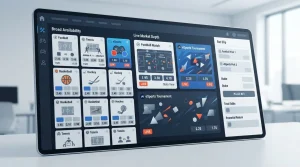


Casino payment pages may describe general support, while the cashier shows which methods are available for a particular account and transaction.
How to Check Whether an Echeque Option Is Actually Available
A payment method mentioned on a casino’s general information page is not proof that it can be selected when making a deposit. The page may describe the service in broad terms, while the cashier shows the methods available for a particular account at that moment. For anyone looking for an echeque online casino in the UK, the cashier is the practical point of confirmation—not a logo, an old review or a payment page taken on its own.
I learned to separate two different claims: “the site lists this method” and “this account can use this method now”. The first is about what the casino says it supports in general. The second is about what its payment flow actually presents to an individual customer. Those claims can differ without either page being deliberately misleading. Payment options can depend on account details, the transaction being started, or changes made to the cashier after a general page was written.
That distinction matters especially for echeques because a broad list can create a false sense of certainty. A page may use a familiar label, or mention bank-based payments without identifying the exact option shown at checkout. Neither establishes that an echeque choice exists in the live cashier. Nor does a search result or an older article prove that the option remains active. Payment information has a short shelf life.
Casinos That Accept USDC in the UK: What to Check
The cashier is the working record
The useful check begins after signing in and opening the casino’s deposit area. The method needs to appear as a selectable option in that flow, rather than only in a list of supported payment brands elsewhere. If an echeque is absent from the available choices, a general statement on another page does not make it available to that account.
I would also check the cashier in the environment intended for use. A method shown on a desktop page should not automatically be assumed to appear in a mobile cashier, and the reverse is also true. The key is not the device itself, but whether the actual payment screen presents the option for the account being checked. A mobile-friendly site can still have a different route through its menus, so a method should not be inferred from the appearance of a general mobile payment page.
Casinos That Accept Bank Cheques UK: Boku Explained
The same caution applies to payment logos. A specialist payment review has listed Visa and Mastercard among methods found on the sites it examined, but that does not establish current UK availability or eligibility for every card product. The cashier remains the place to check what can be used in the current transaction. A logo is a signpost, not a live authorisation.
Check the account, not just the brand
Payment lists are often written as if every customer sees the same menu. In practice, the cashier is tied to an account, so the available choices should be checked after signing in rather than assumed from another player’s screenshot or a generic page. A method mentioned in an operator’s general payment information may not appear for every account.
The distinction is not unique to echeques. A specialist review referring to GBP support, for instance, does not settle the currency set on an individual account. That currency should be confirmed before the first transaction, since a mismatch can introduce conversion. The broader lesson is simple: information about a site’s capabilities does not replace the account-level display.
I would record what the cashier actually shows, including the method’s precise label, before proceeding. Similar-sounding names do not necessarily describe the same payment route. If the choice is unclear, the casino’s own support team can clarify what the label means and whether it is available to that account. A support reply is useful context, but it should not be treated as a substitute for seeing the option in the deposit flow.
A listing is not a confirmation
There are several weaker signals that can be mistaken for confirmation: a payment-method article, a third-party comparison, a search snippet, a logo in a footer, or a menu that describes payments in general. Each may be useful for locating information, but none shows the current account-specific cashier. Pages can remain online after their details have changed; summaries can also compress different payment methods into one broad category.
Do
- Confirm the exact option appears in the signed-in cashier
- Check the cashier in the specific environment (mobile or desktop) intended for use
Don’t
- Treat a logo in a footer or a general payment page as proof of availability
- Rely on third-party comparisons or search snippets for current account-specific access
For a reader comparing echeque online casinos in the UK, the responsible standard is therefore narrow: confirm that the exact option appears in the signed-in cashier for the account in question. Do not treat a casino’s presence on a list—or a phrase such as “bank payment”—as proof of echeque availability. The distinction is procedural, not semantic.
There is also a difference between seeing a method named and being able to complete a transaction with it. At this stage, the relevant question is whether the cashier offers the option, not whether every other condition has been met. I would stop before submitting payment if the displayed method or route does not match what was expected. That avoids turning an assumption made from a general page into an attempted transaction.
No named casino should be called an echeque casino on the strength of a static payment list alone. The available evidence for an individual account is the live cashier, checked at the time the deposit is being considered. Not a logo. Not an old page.
What “Accepts Echeque” Needs to Mean in 2026
When looking for UK casinos that accept e-cheque in 2026, payout timing is one practical detail to check. The notes below give the known payout-speed information for each listed operator.
1. Zombillion
Payout speed: 1-3 business days
Zombillion has a stated payout speed of 1–3 business days.
2. SlotoSport
Payout speed: 1-3 business days
SlotoSport has a stated payout speed of 1–3 business days.
3. Dieselwin
Payout speed: 1-3 business days
Dieselwin has a stated payout speed of 1–3 business days.
4. WinBeast
Payout speed: 1-3 business days
WinBeast has a stated payout speed of 1–3 business days.
5. Britsino
Payout speed: 1-3 business days
Britsino has a stated payout speed of 1–3 business days.
6. Revery Play
Payout speed: 1-3 business days
Revery Play has a stated payout speed of 1–3 business days.
7. NightLuck
Payout speed: 1-3 business days
NightLuck has a stated payout speed of 1–3 business days.
8. NightWin
Payout speed: 1-3 business days
NightWin has a stated payout speed of 1–3 business days.
9. BeOnBet
Payout speed: 1-3 business days
BeOnBet has a stated payout speed of 1–3 business days.
10. Chanze
Payout speed: 1-3 business days
Chanze has a stated payout speed of 1–3 business days.
“Accepts echeque” sounds like a simple yes-or-no statement. In practice, it needs a scope. A payment method can be described in general terms without being available for every account or every kind of transaction. The useful question is narrower: does the casino offer echeque for the specific transaction being considered, on the account concerned?
I learned to be wary of treating a method name as a promise. Payment pages often describe what a business supports in broad terms; they do not necessarily settle what a particular customer can do at a particular point in the account journey. That distinction matters because “accepted” can mean anything from being mentioned as a possible route to being enabled for a particular transaction. Those are not the same thing.
For a deposit, acceptance means the option can actually be selected and used to send money into the gambling account. A reference to echeque elsewhere is not enough to establish that. Nor does a method being available to one customer establish that it is available to another. The wording should be read as account-specific, not as a universal feature of the casino.
Casinos That Accept Interac in the UK: Payment Terms
The same precision applies when the intended transaction is a payout. A casino might refer to a payment method in its general information without confirming that it can send winnings through that route. “Accepts” should not silently expand to mean “accepts deposits and pays withdrawals.” The transaction needs to be named. If the claim is about deposits, it proves no more than deposit use; if it is about withdrawals, that needs to be established separately.
This is a distinction in meaning, not a technicality. Deposit and payout journeys serve different functions. A deposit method moves funds into the account; a payout route returns funds out of it. The fact that a method appears in one context does not make it a two-way service. I have seen broad wording create an impression of a complete payment route where the actual statement was narrower. A small verb can carry a large assumption.
Acceptance of a payment method for deposits does not automatically guarantee that the same method is available for withdrawals.
The account matters too. “UK casinos that accept echeque” may sound like a description of a whole market category, but it can obscure whether the method is enabled for the specific customer. Acceptance is not a permanent property of a casino independent of its account setup. It is more accurate to treat it as a conditional capability: the operator offers the route, and the relevant account and transaction can use it at that time.
That still does not mean every difference is visible in a public description. The key is not to infer more than the wording supports. If a page says a casino supports echeque, that statement should not be read as proof that every account can use it, that it works for both directions of payment, or that it will remain available for a later transaction. The claim needs a subject and an action: which account, which transaction, and what the method is being used to do.
Casinos that accept Neosurf in the UK: what to check
There is also a separate question about where a payout may go. UK anti-money-laundering controls commonly require funds to be returned to the original payment source. Returning money that way is also a familiar anti-fraud measure. So even when a player asks whether an online casino accepts echeque, a positive answer about deposits does not settle the destination of any later payout. Where a different route is proposed, further checks may be needed. That is a control on the flow of funds, not a broader declaration that the method is accepted for every purpose.
I would therefore read “echeque accepted” as incomplete unless the context makes its boundaries clear. It could describe a deposit option, a payout route, or a general payment capability; those meanings should not be merged. A casino’s method list may be useful background, but it is not a substitute for knowing what the statement actually covers. No shortcut.
Casinos That Accept Entropay in the UK: What to Check
This also changes how “best casinos that accept echeque” should be understood. A ranking cannot make an ambiguous acceptance claim precise. Before comparing operators, the underlying claim has to mean the same thing in each case: the same transaction, and an account for which the method is genuinely usable. Otherwise, one entry might refer only to deposits while another implies a broader service. The comparison would look tidy and say very little.
For a UK player, the sound interpretation is deliberately limited. Acceptance means the payment route is supported for the stated action on the relevant account—not that it is available to everyone, works in both directions, or guarantees a particular payout path. The boundaries matter.
Echeque Deposits: Limits, Currency and the Cashier Check
An echeque deposit needs more than a payment button and a blank amount field. The conditions attached to that specific deposit determine whether the intended amount can be submitted and what currency the account will use. I treat the cashier figures as transaction rules, not as background information: a method’s general description cannot tell the whole story about the amount available to a particular account.
The first figure to establish is the minimum deposit shown for the selected route. A specialist review puts minimum deposits across payment methods in the £10–£20 range, but that is not a reliable echeque-specific quote. The amount can depend on the method chosen, so the cashier’s displayed minimum is the relevant one when preparing a deposit. A general site-wide minimum may describe another route or a default value rather than the echeque option.
Attention A general site-wide minimum deposit may describe a different route or a default value rather than the specific requirement for echeques.
That distinction matters in practice. A payment form may accept an amount only after it has been entered, then reject it because it falls below the method’s threshold. That is not evidence that the account has been charged; it is a mismatch between the proposed amount and the route’s conditions. The useful figure is the one presented alongside the selected method, before the transaction is confirmed.
Read the limit as a set of separate rules
The maximum is not necessarily one simple ceiling. A specialist review notes that maximum deposits can be set per transaction, per day or per month, and that the figures may vary with payment method and account status. Those are different controls. A per-transaction cap applies to one deposit; a daily or monthly cap concerns the total accepted over that period.
For an echeque deposit, the distinction affects how a larger intended payment is assessed. A deposit below the transaction maximum could still be affected by an account-level daily or monthly ceiling. Conversely, a limit shown for a different payment route should not be assumed to apply to echeques. The cashier’s terms need to be read against the selected method and the account state, rather than treated as a single universal casino limit.
Account status also matters because the applicable ceiling may not be identical for every account. A figure displayed in a general payment guide can therefore be less useful than the limit attached to the actual cashier flow. In my experience, this is where vague payment descriptions create avoidable confusion: “maximum deposit” sounds definitive, but without saying whether it is per transaction or cumulative, it leaves an important part of the rule unstated.
Casinos That Accept E-Checks in the UK: What to Check
The practical check is to identify the unit attached to each limit. If the cashier states a transaction ceiling, that answers how much can go through in one deposit. If it also gives daily or monthly limits, those describe separate totals. Do not combine them into a single number or infer that unused capacity under one rule overrides another.
Confirm the account currency before entering an amount
Currency is not a formatting detail. A specialist review of the supplied pages says GBP is supported, while also advising that the account currency be confirmed before the first transaction to avoid conversion. The important distinction is between a currency being supported somewhere on a site and the currency assigned to a particular account. The amount entered into the cashier is meaningful only in relation to that account currency and the payment route’s displayed terms.
If the account is set to GBP, an amount entered in pounds can be compared directly with the cashier’s limits expressed in that currency. If the account uses another currency, conversion may enter the calculation. That can affect the amount ultimately represented in the account, so a displayed deposit value should not be read as a promise that the same nominal amount will appear without conversion.
Currency conversion risks
If the account currency differs from the payment route’s currency, conversion may occur, affecting the final amount represented in the account.
I would check the account currency before making the first deposit, then compare it with the currency shown in the cashier for the selected route. If the two differ, the conversion point and resulting amount should be clear before confirmation. The point is not to assume that a payment marked as available in GBP automatically sets every account to GBP; it is to establish the account’s own denomination before committing funds.
A short pre-deposit read
Before submitting an echeque deposit, the cashier should make three things legible: the minimum for that route, the applicable maximums and their measurement periods, and the account currency. The figures belong together. A minimum without a currency can be ambiguous; a maximum without its period can be misleading; and a currency label without the account setting may not describe how the balance is denominated.
This is the difference between seeing an amount field and understanding the conditions attached to it. The deposit decision rests on the cashier’s specific terms for the account and selected method—not on an assumed market-wide figure. Clear figures first. Deposit second.
Comparing Payment Routes Without a “Best” Claim
A payment method cannot be called the cheapest simply because the cashier shows no fee. The visible charge is only one part of the cost. Depending on the route, a transaction may also involve a payment-provider fee, an issuer or bank charge, currency conversion, or a network cost. Those charges can arise in different places, so a comparison based only on the casino’s payment screen can miss part of the total.
That matters when comparing an echeque with another route. The relevant question is not which method has the smallest advertised fee, but how much value reaches the casino account after all charges associated with that transaction. The answer can change with the amount, the account currency and the terms applied by the provider or bank. There is no universal lowest-fee method.
Casinos That Accept Ethereum in the UK: What to Check
The fee shown is not always the full cost
Casino charges are the easiest to notice because they may appear alongside a deposit option or in its terms. A provider’s fee may be disclosed separately, while an issuer or bank can apply a charge outside the casino cashier. A transfer that looks free at the point of deposit can therefore still have a cost elsewhere in the chain.
Currency conversion needs separate attention. If the payment account and casino account use different currencies, the amount may be converted before or during processing. The exchange rate may include a spread: the difference between the rate used for the transaction and a reference rate. A specialist payment review notes that this spread can cost more than a visible flat fee. That is not a rule for every transaction; it is a reason not to treat a small displayed charge as proof that the route is cheaper overall.
Network fees can also matter where a route relies on a payment network. They may not be presented as a casino fee, and their treatment can depend on the service used. The practical comparison is therefore broader than a cashier’s price label.
Compare the same transaction
A useful comparison keeps the conditions consistent. The amount being sent, the currency held in the casino account and the currency used by the payment source all affect the calculation. Comparing one route for a small deposit with another for a larger one can produce a misleading result if charges are fixed, variable, or triggered at different points.
Total Transaction Cost
Comparing payment routes requires calculating the combined cost of casino fees, provider charges, bank fees, and currency conversion spreads.
The same applies to account settings. A casino may display a route without making clear, in the same place, whether a charge comes from the casino, the payment provider or the bank. Those costs should be considered separately rather than collapsed into a vague “free” or “low-cost” label. If the route involves conversion, the exchange rate matters as much as any explicit fee.
For an echeque, the cashier’s stated charge is only one component to check. Any payment-provider terms and possible bank charges belong in the same calculation. Where the relevant rate or charge cannot be established before the transaction, the total cost cannot be compared with confidence. A blank fee field is not a complete price.
Why rankings do not hold up
A “best” payment route implies that one option will suit every account and transaction. That conclusion does not follow from a list of methods or from a comparison of casino fees alone. One route might have no casino charge but involve conversion costs; another might show a flat charge while avoiding a currency exchange. The cheaper result depends on the actual amount and the charges that apply to that particular payment.
This is why a list of casinos labelled as the best echeque choices cannot, by itself, establish the lowest-cost route. A list might show that a method is mentioned or displayed, but it does not calculate the combined cost for a customer’s currency, provider and transaction. Nor does a prominent “no fee” claim explain whether another party in the payment chain charges separately.
Casinos That Accept Tether in the UK: Payments
The sound comparison is transactional, not promotional: identify each possible charge, check whether conversion applies, and compare the total for the same amount. If the rate or an external charge is not clear, that uncertainty should remain visible rather than being replaced by a confident ranking.
In payment decisions, the small print is part of the price. No universal winner.
Echeque Casinos and the UK Payment Context
Payment labels can look familiar while the rules behind them differ. In the UK, the clearest dividing line is between a debit card and a credit card: a card brand alone does not identify which product is being used, and the cashier’s display is not permission to use every card carrying that name.
The regulator’s ban on credit-card gambling took effect on 14 April 2020 and has not been relaxed. Remote gambling licensees cannot accept credit-card payments for gambling. That restriction also covers credit-card funding routed through a money service business, so changing the route does not make a prohibited payment acceptable. A payment flow that presents a card logo still needs to be understood in terms of the actual card product and funding source.
This matters when looking at casino payment information. A specialist casino-payment review lists Visa and Mastercard among the methods mentioned by the sites it covers. That is a record of what those pages list, not confirmation that every card product works for a UK account today. Current availability and eligibility need to be checked in the casino cashier, where the payment choice is presented for the account and transaction in question.
Credit Card Ban
UK remote gambling licensees are prohibited from accepting credit-card payments, including those routed through money service businesses.
I have seen payment pages treated as if a brand name settled the issue. It does not. A debit card bearing a familiar network logo is not the same thing as a credit card, and a general methods page may not capture the conditions applied at the point of payment. The operative detail is the eligible product shown in the live cashier, not the logo in isolation.
The same discipline applies when the search is for an echeque casino in the UK. The UK payment context sets boundaries, but it does not turn a payment label into proof of eligibility. A UK-facing casino must operate within the applicable rules, and a method’s presence in general payment copy should not be read as blanket approval for every customer or account.
“Accepted” can be a broad marketing word. At the payment stage, the useful question is narrower: does the cashier offer the intended method for this UK account, and is the underlying payment product eligible? That distinction keeps a familiar brand from being mistaken for a permitted funding route.
The rule is settled. The cashier still matters.
Deposits Are Not the Same as Withdrawals
An echeque shown in a casino’s deposit menu is evidence that the cashier offers a way to fund an account. It is not, by itself, evidence that the same route can return winnings. Those are separate transaction directions, and a payment method can be available for one without being available for the other.
Casinos that accept MuchBetter in the UK
I have found it useful to read the cashier as a set of distinct routes, not as a single promise about moving money both ways. The deposit screen describes what the account can send in. The withdrawal screen describes the routes the operator can use to pay out, subject to its controls. A familiar method name on the first screen does not settle what will appear on the second.
That distinction matters with echeques just as it does with other payment types. The cashier may accept a deposit through a named route while withdrawals are handled through another eligible route, or the method may not be offered for cash-outs at all. The presence of an option is not a guarantee of two-way support.
UK anti-money laundering controls commonly require a payout to go back to the original payment source. This is a closed-loop approach: funds are returned along the route used to deposit, rather than sent wherever is most convenient after the fact. It is also a common anti-fraud control. The aim is to keep the movement of funds traceable.
In practice, that can make the original deposit route important even where the withdrawal screen presents other choices. An alternative payout method may be considered, but it can bring further verification before the casino releases funds. A different route is not automatically a shortcut.
The practical check is therefore narrow: establish whether the echeque option is for deposits, withdrawals, or both, and note any return-to-source condition attached to the account. A deposit confirmation records money paid in. It does not prove that cash-outs can be made by the same method.
One direction is not two.
Withdrawal Realities
- Deposits and withdrawals are separate transaction directions with different available routes
- UK anti-money laundering rules often require funds to be returned to the original payment source
- A deposit confirmation does not prove that cash-outs can be made via the same method
Payment Methods for UK Players: What the Alternatives Show
The wider cashier can include several routes, but their presence does not establish that any one of them is an equivalent replacement for an echeque. I treat each method as a separate payment arrangement: the name alone says little about what the casino allows for a particular transaction.
Debit cards are a familiar option at UK casinos. Visa and Mastercard are among the card brands commonly accepted, although that does not mean every card product or account will be eligible at every cashier. A card’s logo is only one part of the picture; the available payment route is the one the casino actually presents and permits for that account. Credit-card payments for gambling are not an alternative: UK rules prohibit them.
Open banking and bank transfers occupy a different place in the payment mix. A specialist payment-method review describes these routes as capable of providing instant deposits and fast withdrawals at many sites. That is a report about what may be available, not a promise applying to every casino or account. “Fast” is not a fixed service standard. The cashier’s own terms determine which transfer service is supported and what it can do.
Paysafecard has a narrower role. It is a prepaid voucher for deposits, so it should be understood as deposit-only rather than as a complete route for moving money in both directions. That distinction matters when comparing payment names: two methods shown beside each other in a cashier may support different parts of the account’s payment process.
Casinos That Accept Neteller in the UK
None of these alternatives proves that a casino accepts echeques, nor that an echeque can be used for the same purpose. The useful comparison is functional: a card is a card route, a bank transfer or open-banking service connects with a bank account, and a prepaid voucher funds deposits. Marketing labels flatten those differences. The cashier does not.
I have seen payment lists treated as if they were menus of interchangeable options. They are not. A route’s practical role depends on the transaction the operator has enabled, and on the conditions attached to that route. The alternatives provide context for how a UK casino may handle payments, but they cannot confirm echeque availability by association. That needs its own evidence.
Ownership Checks and Payment Security
With casinos accepting echeques in the UK, the payment route is only part of the ownership picture. The casino account and the account behind the payment should belong to the same customer. When names or other basic account details do not line up, a transaction can attract avoidable questions before it is processed.
I have seen “secure” used as if it described a payment button. In practice, it says little about whether the casino can connect the payment to the account holder. Matching ownership details is the more useful check: it gives the operator a straightforward basis for handling the transaction and reduces friction caused by an apparent mismatch.
Consistency matters too. A single named account used for both deposits and withdrawals is often the cleanest route. It leaves less ambiguity about where the funds came from and where a payout should go. That does not guarantee approval, but it avoids adding a second payment identity to the trail.
Using a single named account for both deposits and withdrawals reduces ambiguity and minimizes friction during ownership checks.
An alternative payout route may be possible in some circumstances, but it can prompt further checks. The operator may need to establish why the destination differs from the original payment route and confirm that it belongs to the customer. That is a security and anti-fraud control, not necessarily a sign that the account has been treated as suspicious.
The practical distinction is simple: using matching details helps keep ownership clear; changing routes can make the trail less direct. Before a transaction, the account name and the payment account should therefore be checked for consistency. Fewer loose ends.
Withdrawal Timing: Approval Comes Before the Money Moves
A withdrawal request is not the same as a payment already on its way. There are separate stages: the casino receives the request, reviews it, approves it and then releases the funds for processing. The time quoted for a payment route may describe only the final movement of money, not the casino’s queue before approval.
A specialist review notes that withdrawal processing can take longer on a first cash-out while verification is completed. That distinction matters: a request can remain under review even when the account balance has been updated to show a pending withdrawal. In practice, the internal decision is part of the timing, not an administrative footnote.
KYC status is a central variable. If the account is not fully verified, the casino may need to complete checks before approving the request. A first withdrawal can therefore involve steps that later requests do not, once the account has passed those checks. The casino’s approval process and the account’s verification status both affect how quickly funds are released; neither is controlled by the payment network alone.
I have seen timing language create the wrong expectation because it compresses these stages into a single promise. “Fast payout” may describe the transfer after approval, while leaving the review period unstated. The wording is not necessarily false, but it is incomplete.
Casinos That Accept Boku in the UK: How It Works
A specialist review also identifies internal approval and completed verification as factors in withdrawal speed. The useful distinction is between waiting for the casino and waiting for the payment to arrive. Those are different delays. No fixed arrival time follows from a method label alone. Check the operator’s stated process and whether account verification is complete before treating a displayed processing estimate as the full journey.
New Casino Cashiers and the First-Deposit Limit Prompt
A new casino account does not move straight from registration to payment. Remote gambling operators must prompt a new customer to set a financial limit before the first deposit, and provide accessible controls for managing account-level limits. The prompt is part of account setup, not a payment-method condition. An echeque appearing in a cashier would not replace it.
From the operator’s side, this step can feel like a pause in the deposit journey. It is also a required control: the account needs a limit before funds can be deposited. The controls should remain accessible after setup, rather than disappearing once the initial choice is made. A new customer may therefore encounter two separate decisions close together: setting the account limit and choosing from payment methods the cashier actually displays.
Casinos That Accept Revolut in the UK
That distinction matters when opening an account at a casino thought to accept echeques. A general payment list is not the same thing as an option offered during that account’s setup. The cashier is where the available methods become concrete, alongside the account details and the first-deposit flow. No assumption should be made that an echeque will appear simply because a site is described that way elsewhere.
A specialist review listing Visa and Mastercard is useful as a pointer, not confirmation that either card product is currently eligible for a UK account. The cashier remains the relevant place to check what is offered and accepted at that point. Card availability can depend on the current UK setup and the particular product.
The order is straightforward: establish account details, set the required financial limit, then inspect the live payment choices before depositing. Separate steps. Separate checks.
What is the fastest withdrawal method for UK casinos?
PayPal, open banking services and debit cards linked to fast payout systems are generally among the quickest options. The casino’s approval process and whether your account is verified also affect how quickly you receive the money.
Why must withdrawals return to the deposit method?
Returning funds to the original payment source is a common anti-fraud and anti-money-laundering control. Using a different route may require additional verification.
Which method has the lowest fees?
There is no universally cheapest method. Compare casino and payment-provider charges, any currency-conversion spread, and network costs for the amount you plan to transfer.
Are Visa and Mastercard deposits definitely debit cards?
No. UK casinos commonly accept Visa and Mastercard debit cards, but a logo or general payment list does not confirm that a particular card product is eligible; check the cashier and your card’s eligibility.
Do UK casino withdrawals require verification?
Verification can be required, particularly for a first withdrawal, and an account that is not fully verified may take longer to pay out.
Are fast casino withdrawals guaranteed?
No. Even with a fast payment method, the casino’s approval process and your verification status affect the timing; bank transfers can also be affected by cut-off times, weekends and currency conversion.
Why can a fast payout casino still delay my withdrawal?
A fast payment method does not bypass the casino’s internal approval process. A withdrawal may also take longer while verification is completed, and bank transfers can be affected by cut-off times, weekends or currency conversion.
Material created by the team Golden Mister