A UK licence confirms authorisation to serve Great Britain, but it does not by itself resolve how well an operator handles customers.
What a UK Gambling Licence Actually Tells You
For remote gambling offered to customers in Great Britain, the basic licensing test is straightforward: the business needs the relevant UK Gambling Commission licence, wherever the business itself is based. A company does not avoid that requirement by operating from another country. What matters is that it offers remote gambling facilities to consumers in Great Britain.
That makes a UKGC Licence more than a badge chosen for a website footer. It identifies the regulatory framework under which the operator is allowed to provide the relevant service in this market. A claim that a casino is “licensed” is meaningful only when it refers to the appropriate licence and the business behind the casino, not merely to an overseas registration or a general statement about regulation.
I have found it useful to separate two questions that marketing tends to run together. First: is the operator authorised to offer this service to people in Great Britain? Second: does the operator handle every part of the customer relationship well? A licence speaks to the first question. It cannot, by itself, settle the second.
That distinction is the starting point for judging whether an online casino is trustworthy. The licence is a necessary regulatory baseline, not a promise that every interaction will be smooth or every decision will suit every customer. A licensed business can still make mistakes, communicate poorly or fall short of the standard expected in a particular part of its operation. Treating a licence as a complete quality verdict gives one fact more weight than it can bear.
The same applies to the word “trustworthy”. In casino advertising, it can sound like a single settled status: once the label is attached, the rest is assumed. In practice, trust depends on evidence about the operator and its conduct. The UKGC Licence answers an important question about permission to serve the British market; it does not turn every promotional statement, service feature or customer outcome into a regulator-certified endorsement.
Casinos & Safety: UK Licensing and Player Checks
Nor should the location of a company be mistaken for the licensing test. A remote gambling business based outside Great Britain still needs the relevant UK Gambling Commission licence if it offers facilities to consumers here. The rule follows the market being served. That is why a casino’s own description of where it is based does not, on its own, establish whether it is authorised to offer gambling to British customers.
There is a further point about the word “relevant”. A licence has to relate to the activity being offered. A broad claim that a company is regulated is not enough to establish that its remote casino service falls within the required UK framework. The regulatory baseline is about the permission needed for the service, rather than the presence of official-sounding language on a page.
A licence also does not mean that the regulator has made a general recommendation to use the operator. It is not a consumer award or a guarantee against disputes. I would read it as a condition of lawful operation in this market, and then keep that conclusion within its proper boundaries. It establishes the framework; it does not remove the need to consider how the operator behaves within it.
No-account casinos in the UK: rules and payments
The record of enforcement illustrates why those boundaries matter. On 26 June 2025, the Gambling Commission imposed a £60,000 financial penalty on Grace Media. The breaches involved self-exclusion and consent for direct electronic marketing. That outcome does not mean every operator has the same problems, nor does it erase the distinction between licensed and unlicensed businesses. It does show that being within the regulatory system is not the same as having a flawless record.
That is a useful correction to both extremes. A licence should not be dismissed as decorative: it marks the legal threshold for a remote gambling business serving Great Britain. But it should not be treated as proof that all aspects of the service are beyond question. One fact, not the whole case.
In my experience, the most reliable reading of a casino’s trust claims begins by asking what the licence actually establishes and stopping short of claims it cannot support. It establishes that the operator needs permission under the Great Britain regime to offer the relevant remote gambling facilities. It does not, on its own, establish that every policy is clearly explained, every customer interaction is handled properly or every risk has disappeared.
Regulatory Baseline
A UKGC licence is a necessary legal threshold for operating in Great Britain, but it is not a guarantee of flawless service or a total quality verdict.
That is the regulatory baseline. Trust begins there, but it is not finished there.
How to Read Trust Claims Against the Rules
“Trustworthy” is not a regulatory status printed on a homepage. I treat it as a conclusion drawn from observable checks: whether the service is authorised for the market it serves, whether it applies required controls before play, and whether its protections are part of the account rather than just promotional language. A polished site can make claims. The useful question is what those claims can be checked against.
For real-money gambling offered to customers in England, Scotland and Wales, the operator needs a UK Gambling Commission (UKGC) licence. The Commission regulates remote gambling offered to consumers in Great Britain. That gives a practical starting point: identify the business responsible for the casino and compare its stated licence details with the regulator’s public information. A badge or a line of small print is not the same thing as confirmation. The details need to correspond to the operator behind the service, not merely to a brand name or a payment page.
This is where “licensed” earns its meaning. It connects the service to an identifiable operator and a regulator with oversight of remote gambling in Great Britain. It does not mean that every account decision will feel fair, every support conversation will be satisfactory, or every marketing phrase tells the whole story. A licence is a checkable basis for assessing the service, not a blanket endorsement of each part of it. That distinction is easy to lose when a page uses words such as “safe” or “trusted” as if they were independent awards.
Merkur Casino Online UK: Games, Login and Site Checks
I look for controls that appear before money is at risk. Under UK rules, verification must take place before a customer can deposit or play. Age checks are part of that boundary: the operator should not treat registration as permission to fund an account and postpone the basic checks until a later inconvenience. Identity or payment-ownership questions may arise as part of the operator’s controls, but the central signal here is timing. A service that lets someone begin real-money play first and promises to check eligibility later is not demonstrating the required sequence.
That sequence matters operationally. Verification is not decorative paperwork added to make a site look responsible. It is a gate on access to gambling. In my experience of how account processes are designed, the clearest policies explain when a check happens and how it affects access, rather than hiding the condition inside a general statement about security. Plain wording does not prove good practice by itself, but vague wording makes it harder to understand what the operator will actually do.
The same test applies to safer-gambling language. A claim about customer protection has more substance when it corresponds to a usable account control, rather than appearing only in a footer or campaign banner. UK rules require remote operators to prompt new customers to set a financial limit before their first deposit and to provide accessible account-level limit controls. That makes the point concrete: a safeguard should be available at the point where it can shape behaviour, not just described after the fact. The interface and the terms should not pull in opposite directions.
Do
- Check if the operator’s identity matches the regulator’s public record
- Verify that age and identity checks occur before deposits
- Ensure financial limit controls are accessible before play
Don’t
- Treat a “safe” or “trusted” badge as an independent award
- Trust a service that postpones eligibility checks until after play
- Confuse commercial promises like “frictionless” with regulatory evidence
I also separate a regulatory requirement from a commercial promise. “Instant approval”, “frictionless”, or “no hassle” may sound reassuring, but they do not explain whether the operator checks age and identity before allowing play. Nor do they establish who holds the licence. Advertising language is built to reduce hesitation; regulatory information is there to make responsibility traceable. Different jobs. A trust assessment should not confuse them.
For a casino that accepts a digital currency such as Ethereum, the currency does not answer the licensing question. The relevant issue remains whether the operator offering real-money gambling to customers in the covered British jurisdictions holds the required UKGC Licence. A crypto-themed brand, a wallet option, or claims about fast transactions cannot substitute for that. I would read the payment presentation separately from the operator’s regulatory identity and the checks that govern access to play. The label is not the evidence.
A sensible reading therefore moves from claim to mechanism: who operates the service, what licence information is stated, whether it matches the regulator’s information, and whether age and identity checks happen before deposit or play. Then comes the practical question of whether account protections are accessible before gambling begins. None of these checks requires accepting a casino’s own adjective as proof. They turn a broad impression into specific things that can be confirmed.
There is no magic wording. A service can say “trusted” repeatedly and still leave the important questions unanswered. Conversely, a clear account of its operator, regulatory standing and pre-play controls gives the claim something testable behind it. That is the difference I rely on: not confidence manufactured by copy, but evidence connected to rules and visible in the way the service works.
Casino Without a UK Licence: What It Means
GAMSTOP, Great Britain and the Limits of the Label
“Not on GAMSTOP” sounds like a clear description of a casino. In practice, it is a label with limited meaning unless the operator’s jurisdiction and regulatory status are understood. It does not, by itself, establish whether a service is trustworthy, who regulates it or what protections apply.
For remote gambling offered to customers in Great Britain, participation in GAMSTOP is a requirement for operators within the UK Gambling Commission’s regime. It became compulsory on 31 March 2020. So a casino that is properly licensed by the UKGC for this market cannot present non-participation as a special feature while still complying with that requirement. The label may instead point towards an operator outside that regime, or be used loosely in marketing. Neither interpretation is proof of quality.
That distinction matters because self-exclusion is not merely a badge beside a brand name. GAMSTOP is a tool for people who want to block their access to participating online gambling services. A business that serves Great Britain under a UKGC licence is required to participate; describing a service as “GAMSTOP-free” does not make that obligation disappear.
The wording can also appeal to people who have chosen to exclude themselves. That is where the sales pitch deserves particular scrutiny. A claim that an operator welcomes customers who cannot use GAMSTOP is not evidence of stronger customer care. It may simply describe a service that sits outside the protections attached to the British licensing system. I would not treat the absence of a self-exclusion connection as a trust signal. It is the opposite of a reason to relax scrutiny.
There is a geographic complication. The Gambling Act 2005 and the Gambling Commission’s remote-gambling remit cover Great Britain: England, Scotland and Wales. Northern Ireland is not within that UKGC remit for remote-gambling provision in the same way. That means a statement about UKGC requirements in Great Britain should not automatically be extended to Northern Ireland.
Attention: A "non-GAMSTOP" label does not establish trust and may indicate that an operator sits outside the protections of the British licensing system.
This boundary can make broad phrases such as “UK casino” imprecise. A service may use UK language or refer to British customers without the label clarifying which jurisdiction it serves or which regulator is responsible. Northern Ireland’s position is distinct; it is not a loophole that turns an operator without the required Great Britain licence into a regulated choice for customers in England, Scotland or Wales.
I have found it useful to separate three questions that advertising often compresses into one: whether an operator holds the relevant licence for the market, whether it must participate in GAMSTOP, and what the “non-GAMSTOP” wording is actually describing. The label answers only the second question indirectly, and even then it cannot establish the operator’s full status. A claim on a page is not a substitute for identifying the business and the market it is serving.
Searches for trustworthy casinos outside GAMSTOP often start from a particular need, but the wording can conceal a serious trade-off. If the service is aimed at Great Britain without the relevant UKGC licence, it is outside the local regulatory framework. A foreign location or a different self-exclusion arrangement does not make it a UK-regulated casino. Nor does the phrase “non-GAMSTOP” prove that any alternative safeguards are equivalent.
Non-UK Licensed Casinos: UK Rules Explained
The practical reading is restrained: for a UKGC-licensed remote operator serving Great Britain, GAMSTOP participation is compulsory. Northern Ireland falls outside that specific UKGC remit, but that jurisdictional difference should not be mistaken for a general assurance about any site using a non-GAMSTOP label. The label alone establishes very little. Verify the market and regulatory context first. Clear enough.
Real-Money Play: Limits, Promotions and the Conditions Behind Them
A cash offer has two separate parts: the headline amount and the conditions attached to it. In my experience, the headline is what gets noticed; the terms determine whether the offer fits the way someone intends to play. A “matched bonus” sounds simple, but the match percentage, maximum bonus, qualifying deposit, wagering requirement, eligible games and expiry conditions all affect its practical value. The wording matters. So does the order in which the conditions apply.
Wagering is the amount that must be staked before bonus-related winnings can be withdrawn. A specialist review uses a £20 bonus with 10x wagering as an illustration: the calculation is £20 multiplied by 10, or £200 in total stakes. That does not mean a player must deposit £200, nor does it mean that staking that amount guarantees a profit. Stakes can lose, and the balance can fall before the required turnover is completed. The figure describes the condition, not the likely outcome.
Offshore Casinos for UK Players: Licensing Explained
The distinction between bonus funds and withdrawable cash also deserves attention. An offer may place bonus money in a separate balance, restrict which games count towards wagering, or set a maximum amount that can be withdrawn from bonus play. Those terms should be read together. A large headline amount with narrow qualifying conditions may be less useful than a smaller offer with conditions that match the intended play. No slogan removes that arithmetic.
Promotional choice is part of the account relationship, not just a marketing preference. Casinos must give customers more control over the kinds of promotions they receive and the channels through which they are sent. That means the relevant settings should be clear enough to distinguish, for example, whether promotional messages are wanted and where they may be delivered. A pre-ticked preference or an unclear opt-out can make the arrangement feel different from the choice implied by the offer.
Limit changes are designed with a specific asymmetry: reductions take effect immediately, while increases are subject to a cooling-off delay.
Limits work differently from promotional preferences. Remote operators must prompt new customers to set a financial limit before the first deposit and make account-level limit controls accessible. The point is not that a limit predicts what someone can afford; it is a boundary the account can apply. I have seen the wording around changes matter as much as the initial setting: reductions take effect immediately, while increases are subject to a cooling-off delay. That asymmetry is deliberate. Lowering a limit should not be obstructed; raising one should not become an instant response to a change of mood.
A trustworthy real-money casino is not established by a generous bonus banner. I would look at whether the offer explains the wagering calculation, what counts towards it, which funds are restricted and when the terms end. Separately, the account should make limit controls and promotion preferences understandable and usable. Those are practical criteria for assessing an online casino’s real-money conditions, not a promise that every session will go well.
The useful test is whether the mechanics can be followed before accepting an offer: what must be staked, which games qualify, what happens to unused bonus funds, and how account limits behave if circumstances change. If the terms leave those points unclear, the headline cannot fill in the gaps. Read the conditions first. Then decide.
Highest-paying online casinos UK: understanding RTP
Slots, Wagering Rules and What the Numbers Mean
A slot’s contribution rate determines how much of each stake counts towards a bonus wagering requirement. A specialist casino review may describe slots as contributing 100%, while live tables and blackjack can count at a lower rate or not count at all. That is a description of a particular offer’s terms, not a rule that applies across every casino. The promotion’s own terms decide which games qualify and how their stakes are counted.
At 100% contribution, a stake counts in full towards the wagering total. If a game contributes less, the same stake makes slower progress; if it is excluded, playing it does not advance the requirement. This is where a headline bonus can look more generous than its practical value. The contribution table is not small print in any meaningful sense. It changes the amount of qualifying play needed.
I have seen players focus on the advertised bonus and overlook the game weighting. That is an easy mistake: the offer is presented as a sum, while the restriction sits in a separate set of terms. A clear offer should state the contribution rates and eligible games before play begins. If those details are hard to locate, the headline alone says little about the effort involved.
Stake size also matters. Under the UK rules, the maximum online slot stake is £5 per spin for players aged 25 and over, and £2 for those aged 18 to 24. These are limits, not targets. A wagering requirement does not override them, and a bonus condition cannot make a larger stake permissible. The permitted amount depends on the player’s age, so the same promotion may take different amounts of time to clear for different customers.
UK Slot Stake Limits
Under UK rules, the maximum online slot stake is £5 per spin for players aged 25 and over, and £2 for those aged 18 to 24.
Online slot spins in Britain must last at least 2.5 seconds, and autoplay is not permitted. Those rules shape the pace of play; they do not reduce the wagering total or improve a game’s contribution rate. A larger stake can move through qualifying wagering faster only within the applicable limit, and it also puts more money at risk on each spin. Faster is not automatically better.
For an assessment of trustworthy online slots, the useful test is whether the rules are visible and consistent: the stake limit, eligible games, contribution rates and treatment of bonus funds should be understandable before play. A licensed casino still has to be judged by the terms attached to the specific promotion. Read the mechanics, not the adjective.
Payment Claims, Withdrawals and the Bitcoin Question
A payment logo tells only part of the story. Deposit and withdrawal availability are separate: a method may accept money into an account without being available for cashing out, or a withdrawal may follow a different route. The practical terms sit in the cashier and payment policy, not in the row of familiar logos.
Timing also needs to be read as a sequence. A withdrawal can wait for the operator’s review before the payment network or bank begins its part. One specialist affiliate review reports PayPal withdrawals clearing in roughly 4–6 hours on weekdays, with the reported window extending to 8–10 hours from Friday to Sunday. The same review gives debit-card withdrawals as taking 2–3 banking days after the operator has reviewed them. These are that review’s reported timings, not a promise that every operator, account or payment will follow them. Weekends matter. So does the step before payment is released.
International Casinos for UK Players: What to Know
Bank transfer claims deserve the same scrutiny. The specialist review reports that a bank may charge £2–£5, depending on its policy. That is not necessarily an operator fee, and the amount should not be assumed to apply to every bank or transfer. The distinction matters: an advertised “free” withdrawal can still leave a cost outside the casino’s control. Small print, not the headline.
I have seen payment copy compress several separate stages into one reassuring word: “instant”. In practice, that may describe only the operator’s processing, or one payment route under particular conditions. It does not establish when the funds will reach a bank account. A useful comparison separates the operator’s review time from the onward transfer time, then checks whether the published estimate is tied to working days, weekdays or a specific method.
Bitcoin raises a different issue. A Bitcoin balance or transaction speed does not establish that a casino is trustworthy, nor does accepting the currency verify who operates the site or what protections apply. A claim that a Bitcoin casino is “trusted” remains a claim until the operator’s identity and its standing for British customers can be checked independently. Currency is not a credential.
The same discipline applies to lists presenting trustworthy casinos: payment information can be one part of a comparison, but a fast method or a wide choice of currencies is not a verdict on the whole service. The useful detail is operational: which method supports withdrawals, what the operator reports about processing, where a bank may add a charge, and which stages the estimate actually covers. Labels are cheap. Timings and conditions are more revealing.
What “Best” Can Mean Without a One-Size-Fits-All Winner
When choosing an online casino in the UK, clear information about withdrawals can help you assess whether an option suits your preferences. The list below highlights the payout timing available for each operator.
1. Zombillion
Payout speed: 1-3 business days
Zombillion lists a payout speed of 1–3 business days.
2. SlotoSport
Payout speed: 1-3 business days
SlotoSport lists a payout speed of 1–3 business days.
3. Dieselwin
Payout speed: 1-3 business days
Dieselwin lists a payout speed of 1–3 business days.
4. WinBeast
Payout speed: 1-3 business days
WinBeast lists a payout speed of 1–3 business days.
5. Britsino
Payout speed: 1-3 business days
Britsino lists a payout speed of 1–3 business days.
6. Revery Play
Payout speed: 1-3 business days
Revery Play lists a payout speed of 1–3 business days.
7. NightLuck
Payout speed: 1-3 business days
NightLuck lists a payout speed of 1–3 business days.
8. NightWin
Payout speed: 1-3 business days
NightWin lists a payout speed of 1–3 business days.
9. BeOnBet
Payout speed: 1-3 business days
BeOnBet lists a payout speed of 1–3 business days.
10. Chanze
Payout speed: 1-3 business days
Chanze lists a payout speed of 1–3 business days.
“Best” sounds like a settled verdict, but it depends on what is being judged. A player may care about game choice; another may put more weight on account controls or whether the operator’s UK-facing identity can be confirmed. A broad label cannot resolve those differences. I have seen the word do more work in a headline than the evidence beneath it.
For a British-facing casino, the useful first check is not a trophy or a review score. It is whether the name and domain presented to customers can be matched to the public Gambling Commission register. The operator’s trading brand, legal entity and website domain may not be identical, so checking only one name can leave the central question unanswered.
One affiliate review’s account of a register check identifies leovegas.co.uk as an active UK-facing domain for operator account 39198, with LeoVegas Gaming PLC listed against that account. That gives a concrete example of how the register can connect a customer-facing domain to a named operator. It is a traceable identity check, not proof that every service decision will be satisfactory.
Verifying an Operator
Identify the Domain
Locate the customer-facing domain used by the casino (e.g., leovegas.co.uk).
Check the Register
Search for the domain in the public Gambling Commission register to find the associated operator account number.
Match the Entity
Confirm that the listed legal entity (e.g., LeoVegas Gaming PLC) matches the operator’s stated identity.
The distinction matters. A polished site can state that it is licensed; the register lets that claim be tested against an official record. If the domain, company name or account details do not line up, the discrepancy needs resolving before the claim is treated as established. No inference about service quality follows from a matching entry alone.
I would not call one casino the best for everyone on this basis. The register answers a narrower, more useful question: whether the stated UK-facing identity corresponds to a listed operator and domain. That is evidence about who is providing the service, not a universal verdict on whether the service suits every player. A label is not a check.
Casino Reviews: Check the Record Behind the Verdict
A casino review is an argument, not a regulatory finding. Its value depends on whether it shows how its conclusions were reached: which operator is behind a brand, what the relevant public records say, and whether the review distinguishes documented events from its own assessment. A confident “trusted” verdict without that trail is difficult to test.
Mobile Casinos That Accept Phone Credit in the UK
One specialist review reported that the UK Gambling Commission’s register associates 333casino.com with Grace Media (Gibraltar) Limited, under account 57869, as a White Label domain. That relationship matters because a brand name and the licensed company behind it may not be the same. The register entry is a checkable detail; it does not, by itself, establish that every claim in the review is accurate or that the operator’s service is faultless.
There is also a separate enforcement record. On 26 June 2025, the Commission issued Grace Media a £60,000 financial penalty over breaches concerning self-exclusion and consent for direct electronic marketing. A useful review would make clear what the penalty concerned and avoid stretching it into claims about unrelated matters. Equally, omitting a relevant enforcement finding while presenting an unqualified trust verdict weakens the review’s case.
The distinction is straightforward: a documented regulator action can be verified, while words such as “safe” or “reliable” are conclusions that need supporting evidence. Review pages may explain their methods, but commercial presentation alone does not establish independence. I look for a clear separation between facts, interpretation and promotional language. If a review names an operator but gives no way to trace the underlying claim, the verdict remains just that: a verdict.
There is no single score that settles the issue. A review can help organise checks, but it cannot replace the underlying record or prove more than that record supports. Specific evidence carries weight. Broad reassurance does not.
Reviewing Casino Verdicts
- A review’s value depends on whether it shows the trail of evidence used to reach its conclusions
- Documented regulator actions and enforcement penalties are verifiable facts
- Adjectives like “safe” or “reliable” are interpretations that require supporting evidence
- A review should clearly separate facts from promotional language
Are Online Casinos Trustworthy? The Answer Depends on the Evidence
“Trustworthy” is not a quality that can be established by a polished website or a confident claim. I treat it as a conclusion that needs evidence: for a casino serving Great Britain, the key starting point is whether its operator can be matched to a UKGC Licence in the Gambling Commission’s public register. The name, stated domain and account details should tell a consistent story.
An entry supports a specific conclusion: the named operator holds a relevant licence. It does not certify every part of the service or settle every question about how an account will be handled. Trust is therefore conditional, not a permanent badge. A register entry is useful evidence; it is not a blank cheque.
The reverse also needs care. A search that returns no matching entry is a reason to pause, but it does not by itself prove why the result is absent or establish any broader allegation. The name may be recorded differently, or the operator and brand may not match. The next step is to check the exact company and domain, rather than treating a search result as a verdict.
A specialist review reported that a Gambling Commission register check dated 26 September 2026 did not identify LuckyPays under that brand or its stated domain, luckypays.io. A separate specialist review described a check dated 25 September 2026 that found no operating-licence entry for Usoftgaming N.V. or Hustles Casino. These are dated observations, not timeless descriptions; register information can change. The point is the method: a brand’s own assurance is weaker than a verifiable match in the regulator’s record.
Online casinos can be trustworthy in the limited, evidence-based sense that their UK-facing operator is identifiable and subject to the relevant local oversight. Where that match cannot be established, confidence should not be supplied by attractive wording or assumption. Equally, an absent entry alone does not prove a particular accusation. Evidence first. Conclusions second.
Offshore Casino Sites: UK Rules and Checks
Verification Before Withdrawal: What the Check Involves
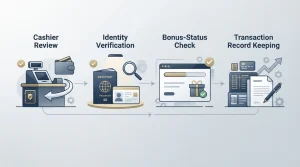
A withdrawal can be the point at which an account’s identity or payment ownership is checked in detail. That is not necessarily a sign that something has gone wrong. From the operator’s side, the check connects the account holder to the details supplied at registration and helps establish that funds are being sent to the right person. The practical issue is whether the requested evidence is clear, current and consistent.
Identity checks commonly involve a photograph of a passport or driving licence, alongside a recent utility bill as proof of address. These documents answer different questions: photo ID confirms identity, while the bill helps confirm where the account holder lives. A document that is cropped, blurred or difficult to read can leave staff unable to complete the review, even when the underlying details are correct. Small details matter.
Timing is less predictable around a first withdrawal. A specialist casino review reports that document checks can add 12–24 hours to the process. That is a reported estimate, not a guaranteed service window: the operator may need to request another document, and the time taken to respond can affect when the review is completed. A withdrawal request and a completed identity check are separate steps.
I treat clear instructions as more useful than a broad promise of “quick payouts”. The important account-level detail is whether the operator explains which documents it needs, how to submit them and what happens if a file cannot be accepted. Those points make the process easier to assess before a withdrawal is pending; they do not establish that every payment will arrive on a fixed schedule.
When looking into how to find a trustworthy online casino, this part of the account deserves its own check. The paperwork itself is ordinary. The handling is what counts: requirements should be stated plainly, and a request for further evidence should identify what needs correcting. A smooth registration tells little about how a first withdrawal will be reviewed. The useful evidence appears when the account is checked.
Is 333 Casino licensed for Great Britain?
Yes. The UK Gambling Commission’s register links 333casino.com to Grace Media (Gibraltar) Limited, account 57869, as a White Label domain.
What is the fastest withdrawal method?
PayPal is the quickest method listed: withdrawals take roughly 4–6 hours on weekdays and 8–10 hours from Friday to Sunday.
Where can I find responsible gambling tools?
You can use GAMSTOP to self-exclude from UKGC-regulated online operators. The National Gambling Helpline is also available 24 hours a day on 0808 8020 133.
Material created by the team Golden Mister