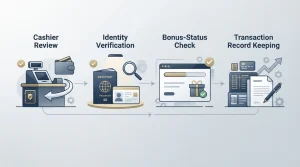
Offshore crypto sites may ask for less information at sign-up, but later checks, public transaction records and different safeguards still matter.
What “Anonymous Crypto Casino” Means in Practice
An “anonymous crypto casino” is usually an offshore gambling site that accepts digital coins and asks for less identity paperwork at sign-up than a UK-licensed casino. The label describes a lighter registration process, not a promise that nobody can identify or check an account. In practice, “anonymous” is a marketing shorthand. The important distinction is what information is requested at the outset and what may happen later.
A UK player may fund an account with Bitcoin or another digital coin and place wagers using that balance. The casino’s games and account are still operated by a business; the use of cryptocurrency does not remove the operator, its terms or its ability to review account activity. Nor does paying from a wallet make the player invisible. A wallet address is not the same as a name, but transactions can leave a record on a public blockchain.
The phrase “no KYC” is often used for sites where registration may be limited to an email address, followed by a crypto deposit. That can mean no passport or utility bill is requested during sign-up. The word “may” matters: registration flows vary, and a quick account opening does not settle what information could be requested later. I have seen the label do more work in the advert than in the actual account journey.
The contrast is with a UK-licensed operator, which has to carry out customer due diligence before it lets a customer gamble. That requirement makes identity checks part of the regulated sign-up process, rather than an optional extra attached to a crypto payment. It does not make offshore registration “anonymous” in an absolute sense; it means the two models approach account information differently.
There is also a difference between choosing crypto as a payment method and using a no-KYC casino. A site can accept digital coins and still ask for personal documents. Conversely, a site promoting minimal sign-up checks may accept crypto because it fits the account model it presents. The terms are related, but they are not interchangeable.
Casinos That Accept Boku in the UK: How It Works
For that reason, I read “anonymous” as a claim about the initial threshold, not the full relationship with the casino. It says little by itself about what happens when an account is used, when a withdrawal is requested, or when the operator reviews activity. Those are separate parts of the process. Less paperwork at the door. Not invisibility.
The practical definition, then, is narrow: offshore online gambling funded with digital coins, where registration can involve less identity documentation than registration with a UK-licensed platform. Before using a no-KYC Bitcoin casino, the relevant local laws should be checked. The label does not turn an offshore site into a UK-regulated service, and it should not be read as proof that every stage of play will remain document-free.
The UK Legal Position—and What Players Give Up
The legal distinction is between the person using a site and the business making gambling available. A UK resident who visits an offshore crypto casino is not committing a criminal offence simply by playing there. That does not make the casino a lawful UK operator. In 2026, the UK Gambling Commission’s position remains that operators serving British residents need a UKGC licence; targeting those customers without one is unlawful for the operator.
That difference is easy to blur in marketing. A site may accept registrations from Britain, display games in pounds or describe itself as an anonymous online casino, but none of those details amounts to permission to serve the British market. The regulator oversees gambling activity in the UK, including online casinos. Access from a British internet connection is not the same thing as UK regulation.
The Gambling Act 2005 governs gambling in England, Wales and Scotland; Northern Ireland has a separate legal framework. For Great Britain, the licensing obligation applies to remote operators serving consumers there, regardless of where the operator or its equipment is based. The practical test is not whether a casino has a page aimed at Britain or accepts a particular payment method. It is whether the operator holds the required UKGC licence to offer gambling to British customers.
Loss of Protection
Using an unlicensed offshore casino means giving up all UKGC-backed consumer protections and formal dispute resolution routes.
What disappears outside the UK system
The most important consequence for a player is the loss of UK-backed protection. If a dispute develops with an unlicensed offshore casino, UK consumer law does not provide the ordinary protection it would offer against a UK-regulated operator. There is no UKGC route for resolving the complaint, no access to the UK system’s formal alternative dispute resolution or an ombudsman, and no UK-backed assurance that winnings will be paid.
The loss is broader than a complaint process. Players give up the regulatory safeguards built around licensed gambling, including protections concerning the handling of customer funds and the operator’s conduct. There is no UK requirement on that offshore business to provide segregated funds for the player’s benefit. A casino’s own terms may describe an internal complaints procedure, but that is not equivalent to independent UK dispute resolution.
From the operator side, this is the point that changes the risk calculation. Under the UK system, a licence brings obligations and external oversight. Outside it, a player may still be able to open an account and place bets, but the UK regulator cannot offer the same consumer recourse when the operator refuses a withdrawal or interprets its terms against the customer. A balance shown on screen is not a UK-guaranteed debt.
That distinction is sometimes presented as a technicality: the player is not prosecuted, therefore the arrangement is treated as acceptable. It is not. The absence of criminal liability for the individual does not turn an unlicensed casino into a UK-regulated one, and it does not restore the protections lost by using it. No UK recourse.
Casinos that accept POLi in the UK: payment guide
A site’s own assurances should be read in that light. Words such as “safe” or “trusted” describe the operator’s claim, not a status granted by the UK Gambling Commission. If a dispute cannot be settled directly, a British player cannot rely on the UKGC’s licensing system to step in as though the casino were one of its licensees. The operator may continue to accept play, but that does not create a UK remedy.
So the legal position is asymmetrical: an individual player does not commit a criminal offence merely by accessing an offshore casino, while an operator that serves British customers without the required licence acts unlawfully. The distinction matters, but it should not be mistaken for a recommendation. For a player, the central cost is practical rather than criminal: fewer enforceable protections, no UK-backed dispute route, and no guarantee that a disputed balance will be recovered.
How Offshore Casino Sites Differ from UK-Licensed Platforms
The important difference is not the currency displayed at the cashier. It is which regulator has authority over the operator, and what a player can rely on if the relationship breaks down. In Great Britain, the UK Gambling Commission’s reach depends on whether a service is offered to local consumers, not on where the casino’s servers or other key equipment are located. A foreign address therefore does not, by itself, put a business beyond the UK licensing requirement.
Regulatory Distinction
A foreign licence identifies a regulator in another jurisdiction; it does not bring an operator under the oversight of the UK Gambling Commission.
The current position creates a distinct category for crypto gambling. The Commission does not license or supervise casinos that accept cryptocurrency payments. UK players can nevertheless reach offshore crypto casinos operating under licences from places such as Curaçao, Anjouan or Costa Rica. Those licences belong to other regulatory systems; they are not substitutes for a UKGC licence.
From inside the industry, I learned to treat a licence as a statement about the operator’s regulatory home, not as a universal promise of recourse. A badge on a site may identify a licensing jurisdiction, but it does not bring the casino within UK oversight or give a British player access to UK-backed consumer protections. The distinction is easy to miss when the site is designed for an international audience. It matters most when there is a disagreement.
At a UK-licensed casino, the local regulatory framework applies to the service offered to British customers. An offshore licence does not create the same relationship with UK authorities. If a dispute arises at an offshore crypto casino, UK consumer law does not protect the player in the way it does within the domestic system. There is no UK-backed formal dispute resolution route, such as access to an approved alternative dispute resolution service or an ombudsman. Winnings are not guaranteed simply because the operator displays a foreign licence.
The practical loss is broader than a complaint process. Playing outside UKGC oversight means giving up UK regulatory protections, including safeguards connected with segregated funds. A foreign regulator may have its own rules and complaint procedures, but those are not equivalent to UK protections, and their usefulness depends on that jurisdiction’s system and the operator’s response. The licence alone does not settle whether a particular complaint will be heard or resolved in the player’s favour.
Cardano ADA Casino Comparison for the UK
“Licensed” sounds reassuring; the jurisdiction is the detail. I would separate three questions: who issued the licence, whether the operator holds permission to serve British customers, and which body can act on a complaint. A foreign licence answers only the first. It does not turn an offshore casino into a UK-regulated platform, nor does it guarantee an outcome if funds or winnings are contested.
This is why the same word can describe two materially different arrangements. A UKGC licence places an operator serving Great Britain under the domestic framework. An offshore licence identifies a regulator elsewhere, while the casino remains outside that framework. The branding may look similar. The protections do not.
Bitcoin Deposits, Confirmations and Withdrawal Timing
A Bitcoin payment has two separate stages at a casino: the transaction must reach the blockchain, then the operator must recognise it and credit the account. Those stages are often compressed into “instant” in promotional copy. They are not the same thing.
At deposit, the casino displays a Bitcoin address, sometimes alongside a QR code and a requested amount. The payment is sent from a wallet to that address. The wallet may show the transaction as broadcast before the casino treats the funds as available. Bitcoin’s network needs to confirm the transaction, and the casino may also require a particular confirmation status before adding the balance. A transaction visible in a wallet is not necessarily a playable casino balance.
Bitcoin Deposit Process
Sending Funds
The player sends Bitcoin from their wallet to the casino’s provided address.
Network Confirmation
The Bitcoin network confirms the transaction, which typically takes 10–30 minutes.
Account Crediting
The casino recognises the confirmation and adds the balance to the player’s account.
A specialist review gives a confirmation estimate of 10–30 minutes for Bitcoin. That is an estimate, not a service deadline: network conditions and the casino’s own crediting process can affect the wait. If a deposit remains uncredited, the useful details are the transaction ID, the address used and the amount sent. They let support trace whether the payment reached the stated destination and whether the operator has credited it. Sending again before checking can create a second payment rather than speed up the first.
The amount requested matters too. A specialist review puts some offshore crypto casinos’ minimum deposits near the equivalent of £10, but that is not a universal threshold. The casino’s payment screen and terms determine its current minimum, and the displayed crypto amount can differ from the amount ultimately credited if the operator applies its own conversion or fee rules. The transaction should be checked against the address and amount shown at the point of payment; a blockchain transfer is not something the casino can simply reverse like an internal balance adjustment.
The practical meaning of “near-instant” needs qualification. A specialist review describes no-KYC Bitcoin casinos as offering near-instant deposits and withdrawals, but even a fast payment still depends on the network and the operator’s controls. For a deposit, a quick broadcast does not remove the need for confirmation. For a withdrawal, an approved request still has to be signed and sent by the casino. Marketing language describes the intended experience, not a guaranteed arrival time.
Mobile Top-Up Casinos UK: Phone Billing Explained
Withdrawal: casino review, then blockchain
A withdrawal starts inside the casino account. The player submits a Bitcoin address and an amount, after which the operator reviews and approves the request. Only after the casino broadcasts the outgoing transaction does the blockchain stage begin. A balance marked as withdrawn can therefore mean the request has been accepted or queued; it does not prove that Bitcoin has already arrived in the receiving wallet.
The distinction is commercially important. The network cannot explain a request that has not yet been sent. If the withdrawal screen shows a pending status, the delay may be at the casino’s review stage rather than a Bitcoin confirmation. Once a transaction ID is available, it can be checked on the blockchain. Before that point, the operator is the party able to explain the status.
A specialist review reports that first withdrawals may undergo a manual review lasting a few hours. It also describes withdrawals at trusted operators as being processed in under an hour after internal review, with crypto then sent instantly. Those are source-specific descriptions, not commitments that apply to every casino or every account. “Instant withdrawal” may refer to the operator’s release of funds, while the wallet’s receipt depends on the transaction being broadcast and confirmed.
I have seen the wording around payout speed do a lot of work. A casino can advertise fast withdrawals while retaining time for an internal check before it releases anything. That does not by itself show that a request will be delayed; it means the advertised speed should be read as conditional on approval. First payouts may be treated differently from later ones, and a submitted request is not the same as a completed blockchain transfer. Two clocks. Two decision-makers.
Do
- Keep a record of the withdrawal reference and amount
- Save the transaction ID once issued
- Verify the destination wallet address
Don’t
- Confuse a “pending” casino status with a blockchain delay
- Assume a processed label equals wallet receipt
- Send multiple deposits to speed up one payment
A careful record makes a payment problem easier to isolate: the casino’s withdrawal reference, the destination address, the amount requested and, once issued, the transaction ID. If the casino says it has sent the funds, the transaction ID is the key detail for separating an on-chain delay from an operator-side hold. If no transaction has been broadcast, the blockchain cannot provide an answer.
The same discipline applies to deposits. A transaction ID can show whether funds were sent and whether the network has confirmed them, while the casino’s account history shows whether it has credited the deposit. Those records describe different steps. Confusing them can make a normal processing gap look like a missing payment—or let an operator’s delay be mislabelled as a network problem.
Bitcoin makes payments traceable on its public ledger; it does not make the casino’s internal accounting visible. The blockchain can verify the movement of coins between addresses, but not whether the casino has applied the payment correctly, approved a withdrawal or decided to release a balance. That part remains an operator process, with its own terms and support channel.
The reliable distinction is simple: blockchain confirmation concerns the transaction; casino processing concerns the account decision. A fast network cannot guarantee fast approval, and a casino’s “processed” label is not proof of wallet receipt. When those stages are kept separate, deposit and withdrawal timing becomes easier to understand without mistaking a marketing claim for a promise.
Casinos That Accept Giropay in the UK: Payment Checks
Other Cryptocurrencies, Volatility and Cashing Out
Bitcoin is not the only coin accepted at offshore crypto casinos. UK players may also wager with other digital currencies, including Litecoin. The choice can affect more than the payment route: each coin has its own network, and its value against sterling can move while funds are held in an account or in transit.
A specialist review describes Bitcoin confirmations as taking 10–30 minutes and Litecoin confirmations as taking a few minutes. Those figures concern the network, not the casino’s handling of a payment, and should not be read as a promise about how quickly a balance will appear or a withdrawal will complete. The distinction matters. A faster-moving network does not make the value of a coin stable.
That is the central cash-out risk. A balance shown in cryptocurrency can be worth more or less in pounds by the time it is converted. The same movement can affect a deposit: the sterling value of the coins sent may differ from the value later available for play. “Crypto-friendly” says nothing about protecting that value. There is no fixed sterling equivalent unless the operator specifies how it calculates one.
Winnings intended for everyday spending generally need to pass through an exchange or another conversion service. That is where the idea of a no-KYC casino can stop being relevant. An exchange may require identity checks before allowing a withdrawal or conversion to fiat currency; the casino’s registration policy does not control the exchange’s rules. The verification point has moved, not necessarily disappeared.
Cash-out Risks
Attention: Cryptocurrency balances are subject to volatility, and identity checks may still be required by exchanges when converting coins to fiat currency.
I have seen people treat the casino balance as if it were already cash. It is not. The practical amount depends on the coin’s value at conversion and on whether the exchange accepts the transaction after its own checks. That is a separate decision from whether a casino accepted the original deposit.
No-KYC Registration: What It Usually Asks For
The lighter sign-up route is generally built around an email address or a connected cryptocurrency wallet. In some cases, the form may ask for little beyond an email, with the account funded in crypto rather than opened by submitting a passport or utility bill. That is the practical meaning of a no-KYC casino at registration: fewer identity documents at the front door, not proof that the account is anonymous in every respect.
I separate the account-opening step from what happens later. An email can identify the account without establishing the player’s full identity; a wallet connection can provide a route for deposits without supplying conventional identity paperwork. Neither arrangement changes the operator’s location, licensing status or obligations. A short form is a registration design, not a regulatory category.
The wording “anonymous” can overstate what the process delivers. The operator may still hold account details, and a wallet is not the same thing as a guarantee that activity cannot be associated with a user. The narrow claim is that the initial sign-up may not ask for the documents a conventional identity check would require. Nothing more should be read into it.
Casinos that accept Maestro in the UK: what to check
There is also a hard distinction between creating an account and being permitted to deposit. UK-licensed operators must complete customer due diligence before gambling transactions, and operators must verify a customer’s age before allowing funds to be deposited. An offshore site’s simpler process does not make it a UK-licensed service or remove the need to consider local law. I would not treat ease of registration as evidence that the arrangement is lawful or protected.
For a UK-based player, checking the local legal position matters before using a no-KYC Bitcoin casino. The fact that a site accepts an email or wallet does not settle whether its service is authorised for British customers. Registration tells only how the account is opened.
The useful test is modest: what information does the sign-up screen request, and what does the site say may be required later? A minimal form can reduce paperwork at the outset. It cannot promise that every later step will remain document-free. That boundary matters.
“No Verification” Has Limits
“ No verification” is a marketing shorthand, not a promise that an account will never be checked. A no-KYC casino may allow play with little information at sign-up, yet retain terms that permit identity checks later. The distinction matters most when money is due to leave the account: the withdrawal can trigger a review that did not appear during registration.
A specialist review describes requests for identification in cases involving a large withdrawal, suspected unusual activity, or a move from crypto to fiat. These are reported examples, not a rule shared by every operator. The practical point is that the site’s wording and its withdrawal terms need to be read together. “No KYC” can describe the opening of an account, while leaving room for checks when its risk team considers them necessary.
Soft KYC Methods
Operators may use geolocation, IP details, browser/device fingerprints, and blockchain transaction tracing to assess accounts without requesting documents.
Checks may also involve information beyond a passport or proof of address. A specialist review identifies geolocation, IP details, browser and device fingerprints, blockchain transaction tracing and withdrawal behaviour as possible inputs to what is often called soft KYC. That does not mean every casino uses every method, or that a player can see what signals are being assessed. It means that submitting no documents is not the same as leaving no trail.
The risk is not only delay. A specialist review recounts a case in which an operator’s security team first cited suspected fraud, voided bets, then changed its stated reason to multiple accounts; the review also alleged that verification was used to confiscate funds from players in profit. That is an account of a particular dispute, not proof that all verification requests are abusive. But it shows why clear terms, dated records of transactions and written explanations matter if a decision is challenged.
For UK players, an offshore site’s internal review does not become a UK-backed process. Consumer law does not protect players in disputes with such casinos, and there is no UK regulator or formal dispute route to rely on. Winnings may not be guaranteed. Minimal paperwork has a trade-off. Less privacy is not the only risk.
Casinos that accept Neosurf in the UK: what to check
No-Deposit Bonuses and the Wagering Small Print
A no-deposit bonus can look like playable money, but the headline value is only one part of the offer. The important question is what must happen before any resulting balance can be withdrawn. Offshore crypto casinos may attach wagering requirements to bonus funds or to winnings generated from them. Until those conditions are met, the displayed balance may not be cash that can be freely withdrawn.
A specialist review of offshore crypto offers reports wagering requirements ranging from 35 to 50 times the bonus amount. That is a source-specific finding, not a fixed rule for every casino or promotion. The wording of an individual offer matters: the terms should say what balance the multiplier applies to, which bets count towards completion, and whether the bonus itself or only winnings can eventually be withdrawn.
The arithmetic can make a small-looking offer demanding. If wagering applies to the bonus amount, the required play is calculated from that amount multiplied by the stated requirement. If it applies to a combined bonus-and-deposit balance, the target can be larger. Those distinctions are easy to miss when the promotion is presented mainly as a free entry point. The label does not settle the calculation.
Which games count
A game’s availability does not mean it contributes fully to wagering. A specialist review reports that some casino bonuses exclude live games from their requirements. Terms may also distinguish between game categories, so play on one title could contribute differently from play on another—or not count at all. The offer rules, rather than the lobby, determine progress.
Wagering Contributions
Not all games contribute equally to bonus requirements; for example, some offers may exclude live games entirely.
This is where a bonus can change the way a player would otherwise choose to play. Someone drawn to live tables may find that those bets do not advance the requirement, while eligible slots do. That does not make the offer worthless by definition; it means its practical value depends on whether its qualifying games suit the intended play. A large balance with narrow eligibility can be less useful than a smaller, clearer offer.
Bet caps matter
Wagering rules can also limit the stake permitted while a bonus is active. A specialist review identifies maximum bets as low as £5 in some offers. That is not a universal cap, and the operative figure must be checked in the specific terms. Exceeding a stated limit can put bonus eligibility at risk, even if the bet itself was accepted by the game.
The wording may apply the cap to each spin or hand, or describe it in another way. I treat that detail as material, not decorative. A player who does not notice it may complete much of the wagering and then discover that a breach gives the operator grounds to remove the bonus or associated winnings under its rules. Terms should explain the consequence, not merely state a limit.
The interaction between eligible games, permitted stakes and the wagering target is the real offer. A no-deposit bonus for an anonymous Bitcoin casino may sound frictionless, but its promotion does not make the funds unconditional. “Free” is the advertising word; the conditions decide what can be kept.
Casinos That Accept Revolut in the UK
In Britain, an offshore casino does not become a UK-regulated service because it accepts British players or offers a bonus. If a dispute arises, UK consumer law does not protect players at an unlicensed offshore casino, and there is no UK-backed dispute resolution. Winnings are not guaranteed. That exposure sits alongside the promotional terms, not apart from them. A bonus can be carefully described and still leave the player without UK regulatory protection.
For a meaningful comparison, the headline amount is the least revealing part. The wagering base, qualifying games, stake cap and consequences of breaking a condition show what the offer actually permits. Read together, those clauses explain whether the bonus is usable or merely attractive on screen.
Promo Codes: Check the Conditions Before Applying One
A code is an entry key, not a description of the deal. “Anonymous” may signal that an offer is aimed at a no-KYC casino account, while “bonus” says little about what must happen before any resulting balance can be withdrawn. The code itself does not settle the important points; the offer’s terms do.
I have seen codes treated as the offer, when they are really just a label the cashier or promotion page recognises. Before applying one, the relevant terms are the qualifying deposit, which accounts or games are eligible, how the bonus is credited, and what wagering is required. A code can be accepted and still attach conditions that make the bonus less useful than its headline suggests.
Applying a Promo Code
- Check the qualifying deposit amount
- Verify which games are eligible for wagering
- Confirm the wagering multiplier (e.g., 35x–50x)
- Identify any maximum bet caps per spin or hand
The figures also need context. One specialist review reported wagering requirements in the 35x–50x range for offshore crypto casino bonuses. That is a report about offers it examined, not a fixed rule for every promotion. The calculation matters: the terms should make clear whether wagering applies to the bonus, the deposit, or another stated amount. A large multiplier on a small bonus is not interchangeable with the same multiplier on a larger balance.
Game eligibility can change the arithmetic. One specialist review noted that some casino bonuses exclude live games from wagering. A game that appears in the lobby may therefore contribute nothing towards clearing that particular offer. The same review reported that wagering terms can set a maximum bet as low as £5. A stake above the stated cap may affect eligibility or the bonus balance, depending on the terms.
I would read the promotion page before entering a code, then check that the displayed offer matches those terms after it is applied. A code can activate the wrong promotion, or an offer may not be available to every account. If the conditions are unclear, the safest assumption is not that the code overrides them. It does not.
What “Best” Can Mean Without UK Safeguards
Choosing an anonymous crypto casino in the UK calls for attention to practical details, including how long payouts may take. Use this list as a reference when considering your options.
1. Zombillion
Payout speed: 1-3 business days
Zombillion lists a payout speed of 1–3 business days, a useful detail to consider when reviewing payout expectations.
2. SlotoSport
Payout speed: 1-3 business days
SlotoSport lists a payout speed of 1–3 business days. This gives readers a stated timeframe to keep in mind.
3. Dieselwin
Payout speed: 1-3 business days
Dieselwin lists payouts as taking 1–3 business days, providing a clear reference point for payout timing.
4. WinBeast
Payout speed: 1-3 business days
WinBeast has a stated payout speed of 1–3 business days. Consider this timeframe when assessing whether its payout timing suits you.
5. Britsino
Payout speed: 1-3 business days
Britsino lists a payout speed of 1–3 business days, giving readers a concrete detail about payout timing.
6. Revery Play
Payout speed: 1-3 business days
Revery Play lists payouts as taking 1–3 business days. This stated timeframe is the available point of reference for its payout speed.
7. NightLuck
Payout speed: 1-3 business days
NightLuck lists a payout speed of 1–3 business days, a practical detail to consider when reviewing the operator.
8. NightWin
Payout speed: 1-3 business days
NightWin has a stated payout speed of 1–3 business days. Readers can use this as a reference for payout timing.
9. BeOnBet
Payout speed: 1-3 business days
BeOnBet lists payouts as taking 1–3 business days, offering a stated timeframe to consider.
10. Chanze
Payout speed: 1-3 business days
Chanze lists a payout speed of 1–3 business days. This is the available factual detail about its payout timing.
“Best” is a slippery label in this market. A polished site, a prominent licence badge or a claim of anonymous play can describe the sales pitch; none establishes that a British customer has UK regulatory protection. I would assess an offshore crypto casino by the practical terms behind its claims, not by the confidence of its wording.
The first test is whether the payment process is explained clearly. A site should distinguish its own approval stage from the time a crypto transaction takes to move through the network. It should also set out what can delay a withdrawal and how a customer is told that a payment has been held. A specialist review has described crypto withdrawals being sent soon after an operator’s internal review, with that review taking under an hour at operators it considers trusted. That is a report about some operators, not a service standard or a promise that applies across the market.
Verification expectations matter just as much. A “no KYC” label is not a guarantee that an account will never be checked, nor does it settle what happens if a withdrawal is questioned. The useful measure is whether the operator’s terms explain its powers and whether the procedure appears consistent. An unclear policy leaves the customer guessing at precisely the point when access to funds matters.
Then comes the boundary that marketing cannot remove. The UK Gambling Commission requires operators serving British residents to hold its licence. Offshore crypto casinos sit beyond that system, so a player cannot rely on UK-backed consumer safeguards if a dispute develops. UK consumer law does not provide the same protection against an offshore operator; there is no UK alternative dispute resolution route or ombudsman process to turn to. Nor is there a UK regulatory framework requiring segregated funds for that operator. Winnings may not be guaranteed.
That changes the meaning of a “best” choice. A quick payment claim is not a substitute for an enforceable remedy, and a licence from elsewhere does not bring a site under UKGC supervision. Playing at an offshore site is not a criminal offence for an individual in the UK, but that does not make the arrangement UK-regulated or restore the protections given up. I treat that distinction as central, not as fine print.
A cautious assessment therefore looks for specific, readable payment and verification terms, a clear complaints route, and claims that can be separated from independent oversight. It also asks what recourse remains if the operator blocks an account, delays a payment or rejects a complaint. If the answer depends entirely on the operator’s own decision, that is a material risk, however persuasive the branding.
There is no reliable shortlist that turns those trade-offs into a safe recommendation. “Best” can only mean comparatively clearer terms and more transparent handling within an offshore setting—not UK approval, guaranteed winnings or consumer protection. The distinction is stark.
Is it legal to play at an anonymous crypto casino in the UK?
Yes, playing at an unlicensed offshore casino is not a criminal offence for an individual in the UK. However, operators serving British customers must hold a UKGC licence, and using an unlicensed site means losing UK-backed consumer protections and formal dispute resolution.
What is a no KYC casino?
A no-KYC casino is a gambling site where registration may require only an email address or wallet connection, without asking for identity documents at the outset. It may still request ID later, for example for a large withdrawal or suspicious activity.
Can I play with Bitcoin without providing any ID?
Yes, some no-KYC casinos allow sign-up and Bitcoin deposits without passport or utility-bill documents. However, they may request ID later, including for large withdrawals or suspicious activity.
How long do withdrawals take?
Crypto withdrawals are usually processed after the casino’s internal review, which can take under an hour for trusted operators; a first withdrawal may face a manual review lasting a few hours. Bitcoin confirmations can then take 10–30 minutes.
Material created by the team Golden Mister