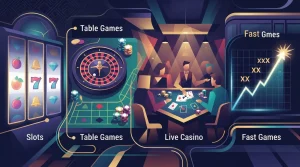
An overview of game formats, demo limits, bonus conditions and the uncertainty behind casino outcomes.
How Online Casino Games Fit Together
A casino game is not defined by the screen on which it appears. Online, the same broad idea—placing a stake on an outcome—can be presented through different formats, with different rules and ways of organising play. That distinction matters when a title such as Mines is being assessed: its name alone does not establish whether it belongs with a machine-style game, a table format or another category.
I learned to look past the lobby labels. A casino site groups games to help people browse, but those menus are a shop window, not a reliable guide to how each game works. The useful questions are more basic: does play involve a machine or equipment selecting outcomes, is there a dealer or croupier, and are players competing with the casino or with one another? A clear answer to those questions says more than a category badge.
Machine-style play
Gambling machines are generally designed for one player at a time and do not need a casino employee to run each round. In an online setting, the player interacts with a digital interface, while the game equipment handles the play behind it. That is a broad description, not a claim that every game shown on a screen is a machine game in the same sense.
Some casino games use random numbers selected by a computer or other gaming equipment. The interface may show cards, symbols, a grid or another visual arrangement, but the presentation is separate from the mechanism that selects the result. A vivid animation does not, by itself, tell me how a game is organised. Nor does a familiar visual layout prove that two games follow the same rules.
Monopoly Live in UK Casinos: Gameplay and Rules
This is where Mines can be easy to misread. The title suggests a particular kind of board, but a name and a graphic are not enough to establish the underlying format. The actual rules and product description need to explain what the player does and how the game proceeds. “Simple” is an advertising word; often it describes a clean interface, not the full set of rules.
Table games and shared formats
Table games are organised differently. Players compete against the casino rather than against one another, and play is usually conducted by a croupier or dealer. Online, that format may be represented through a digital table or a live presentation, but the central structure remains the relationship between the player and the house.
Not every game involving cards is automatically a table game in the traditional sense. Hi-lo, for instance, asks a player to predict whether the next card will be high, low or the same. That description identifies the decision at the centre of the game; it does not, on its own, settle how a particular online version is delivered or grouped on a casino site.
There is another important distinction: not all casino play is player-versus-house. In games such as poker, players may compete against one another, while the casino earns money through a commission known as a rake. That is a different commercial arrangement from a game in which the player faces the casino directly. The distinction is structural, not cosmetic.
Delivery is not the same as category
Online casinos make games available through digital interfaces where permitted by law. Within those interfaces, a game can be encountered in a lobby, a category page or a search result. Those placements help with navigation, but they do not replace the rules. One title may appear under more than one menu label, while a label may group together games that only look similar.
For a Mines casino game, the sensible starting point is therefore not to assume that the word “casino” or the familiar grid settles its classification. The product’s own description should clarify what generates the outcome, what choices are available and whether a dealer or other participants are involved. If that information is vague, a category label cannot fill the gap.
From the industry side, I have seen how a polished presentation can make a format feel self-explanatory. It rarely is. The delivery method tells how a game reaches the screen; the rules tell what happens within it; and the category is only a filing choice. Keep those layers separate. Then the title can be considered on its actual terms, rather than being assigned to a familiar group by appearance alone.
Online Play and the UK Market Divide
Casino games can be offered through online casinos where the law permits them. That broad description does not make every site serving a British audience part of the same system. For a UK player looking for a Mines-style game, the important distinction is not simply whether a page loads or a game appears in a menu. It is whether the operator sits within the UK regulatory framework.
A specialist affiliate review describes the UK online casino market in 2026 as two parallel worlds: UKGC-regulated operators on one side, and offshore platforms outside that system on the other. That is a useful way to frame the difference, provided it is treated as a description rather than a complete map of the market. The boundary matters more than the label: a site can be accessible to UK players without holding a UK Gambling Commission licence.
Casino Dice Games in the UK: How They Work
Access and regulatory status are different things
Offshore casinos do accept UK players, but they operate outside the UKGC framework. Their accessibility does not itself establish that they are licensed to serve people in Britain. This is where casual comparisons can become misleading. Two sites may both present online casino games, yet their position under UK rules is not the same.
The Gambling (Licensing and Advertising) Act 2014 established that an operator seeking to take bets from British residents must hold a licence. In other words, the relevant question is not only where a company is based or what its website calls itself. The question is whether it has the required authorisation to offer gambling to the British market. An offshore location does not remove that requirement.
I have seen how easily a familiar-looking interface can flatten these distinctions. A menu, account page or game tile tells a visitor what the platform presents; it does not, by itself, tell them whether the operator is within the UKGC system. Presentation and regulatory status are separate checks. Plainly so.
What this means for Mines searches
The phrases “Mines casino” and “online casino Mines game” can point to different things: a game presented by a UKGC-regulated operator, or a game found on an offshore platform that accepts UK players. The wording alone does not identify the operator, its licence status or the legal position of the service. Nor does a game’s presence on a site establish that the site is authorised for the British market.
That distinction is easy to miss because game discovery tends to happen through the product itself. Someone sees a title, searches for it, and lands on a page that appears to offer the same kind of play. But an online casino is not defined only by its games. The operator behind it matters. When comparing an online casino with Mines, the relevant context includes whether the operator belongs to the UKGC-regulated space, not merely whether the game can be opened.
Regulatory Status
An offshore casino may be accessible to UK players, but this does not mean it is licensed by the UK Gambling Commission (UKGC) to serve the British market.
The same caution applies to broad labels such as “UK casino” or “casino for UK players”. They may describe an intended audience or a site’s marketing, but the wording is not proof of a UKGC licence. Offshore casinos may accept UK players while remaining outside the UKGC system. Access and authorisation are not synonyms.
A practical way to read the market
I would separate three questions that are often compressed into one: Is the site accessible from the UK? Does it offer the game being sought? Is the operator licensed for the British market? The first two concern access and catalogue; the third concerns regulatory status. A clear answer to one does not settle the others.
This is also why a search for Mines online should not be treated as a comparison of interchangeable destinations. A result may lead to a regulated operator or to an offshore platform. Those are different market contexts, even if both display casino games and accept visitors from the UK. The operator’s own presentation may make the distinction less prominent than the game itself, so the licence status deserves attention as a separate matter.
The market is therefore not one uniform collection of sites. UKGC-regulated operators occupy the authorised British framework; offshore platforms that accept UK players operate outside it. That is the useful divide—not a claim that every platform behaves alike, or that a game title tells the whole story. A Mines game may be the reason for looking, but the operator’s position is what gives the offer its market context.
JetX Casino Game in the UK: What to Check
Free Play, Bonuses and the Conditions Behind Them
“Free” can describe two different things on a casino page. It may mean a game can be opened without staking cash, or it may refer to a bonus supplied by the operator. Those are not interchangeable. A no-deposit bonus is credited without requiring an initial spend, but it remains an incentive with conditions attached. A game available at no cost is not necessarily a bonus, and a bonus does not make every game or every result cost-free.
That distinction matters when looking for a Mines game to try without paying. The word “free” may refer to access to a version of the game, or to promotional funds that can be used under stated rules. A review should make clear which it means. Otherwise, “free play” can sound like an uncomplicated offer when the operator is actually describing a bonus balance that has restrictions before any winnings can be withdrawn.
I have seen this wording do useful work for an operator: it attracts attention before the qualification is read. The qualification is where the offer becomes concrete. It may specify who can claim it, which games count, how long the funds remain available, and what must happen before a withdrawal is possible. Those details are not small print in the practical sense. They define the product being offered.
A no-deposit bonus is credited without requiring an initial spend, but it remains an incentive with conditions attached and is not the same as a cost-free game.
Read the offer as a set of conditions
The headline amount, if there is one, is only one part of a promotion. The wagering requirement determines how much qualifying play is needed against bonus funds. A requirement expressed as a multiple is applied to the stated bonus amount, not treated as a promise that the balance will survive until completion. A £20 bonus with 10x wagering, for instance, means £200 in total stakes must be placed before cash-out eligibility. That is turnover, not a prediction of the final balance.
For gambling incentives from 19 January 2026, a specialist review reports a ceiling of 10x wagering on bonus funds. The practical point is to check the offer’s wording rather than infer the requirement from its headline. A bonus described as “generous” can still have conditions governing eligible stakes, excluded games, expiry, and withdrawals. The permitted wagering figure is one part of the picture, not a guarantee that the stated bonus becomes withdrawable cash.
Promotion rules also determine whether the game being considered contributes towards the requirement. A Mines casino game review that discusses an offer should separate the game’s own rules from the promotion’s rules. The former explain how play is presented; the latter decide whether activity qualifies for the incentive. A page can describe the game accurately and still leave a reader unclear about whether its stakes count. That is a material omission.
One incentive cannot combine different gambling product types, such as casino play and betting, as a condition for unlocking a reward. This is worth checking when an offer is presented across several sections of a site. A casino promotion should not quietly depend on completing betting activity as well. The terms should identify what the incentive covers, rather than leave the customer to piece together a mixed requirement from separate pages.
Crash Casino Games in the UK: How They Work
What “no deposit” leaves unanswered
“No deposit” answers one narrow question: whether an initial payment is needed to receive the bonus. It does not, by itself, explain what the credited funds can be used for, whether winnings are subject to a cap, which games qualify, or whether verification is needed before a withdrawal. Those are separate conditions. The phrase describes how the offer begins, not what it ultimately delivers.
The same caution applies to “free spins” or bonus funds advertised beside a game. The label does not settle whether winnings can be withdrawn immediately, whether the promotion expires, or whether only particular play counts. Terms should be read as operating instructions for the offer, not as a footnote to its headline. A missing or unclear condition can change the value of the promotion more than the advertised amount does.
For UK offers, eligibility also matters: promotions are for UK residents aged 18 or over. Operators must verify age before allowing a customer to deposit into a gambling account. The offer’s own rules may set further eligibility conditions, so a general banner should not be treated as confirmation that a particular account qualifies.
When assessing Mines casino rules alongside a promotion, keep the two documents distinct. The game rules describe the play; bonus terms describe the incentive and its restrictions. I would not treat a “free” label as a substitute for either. Clear terms. Separate questions.
Bonus Wagering
Calculate Turnover
Take the stated bonus amount, such as £20, and multiply it by the wagering requirement, for instance 10x.
Determine Total Stakes
In this example, £200 in total stakes must be placed before any winnings can be withdrawn as cash.
What a Demo Can—and Cannot—Show
A Mines casino demo can make a game’s presentation easier to assess before any cash is involved. It may show how the screen is arranged, where the controls sit, what information is displayed and how a round is presented. That is useful for deciding whether the interface is clear enough to follow. It is not a preview of what a later paid session will produce.
I separate those two questions. A demo can show how the game behaves as an interface; it cannot establish that a particular result is likely, due or repeatable. Random-number games use numbers selected by a computer or other gaming equipment. Seeing a run of outcomes in practice mode does not turn that run into evidence about what comes next. It is a record of what happened in that session, not a signal.
There is also a gap between practice and staking money. In a demo, the displayed balance is not cash at risk, and a displayed gain does not establish that the same result would occur in paid play. The difference matters even when the screen appears similar: the emotional weight of a decision changes when money is involved. A calm trial can feel very different from a real-money session. That is not a minor detail.
Before treating a casino Mines demo as a useful test, it helps to know what it is being used to test. Interface clarity, legibility and whether the rules are presented in a way that can be understood are reasonable things to observe. A demo can also help establish whether the format is enjoyable enough to continue exploring. It cannot answer whether playing for cash is worthwhile, or whether practice has improved the chance of a favourable result.
The word “free” can blur that distinction. Here, it should mean only that the trial does not involve staking cash. It does not make the experience identical to paid play, and it does not imply that any displayed balance can be withdrawn. Nor does it turn a sequence of practice outcomes into a dependable guide. I have found that this is where expectations get ahead of what the screen can actually demonstrate.
Aviator Casino Game UK: Labels, Offers and Checks
A demo also has limits as a test of the product itself. The version available for practice may not expose every detail that matters in paid play, and its appearance alone cannot verify how a game is configured elsewhere. The sensible reading is narrow: it offers a chance to inspect what is presented in that session. No more than that.
For anyone looking for a Mines demo in the UK, the key distinction is not the label on the launch button but the purpose of the session. Practice can reduce uncertainty about the interface. It cannot remove uncertainty from outcomes, prove that a future session will match it, or stand in for the experience of risking money. A useful preview. Not a promise.
Playing Without Mistaking Luck for Control
When I think about how people play a casino game, I separate the experience at the table or screen from the arithmetic behind it. A player commits cash or chips to an outcome, or to a combination of outcomes, and may receive a return if the result qualifies. That is the basic exchange. The interface can make it feel like a sequence of personal decisions, but a decision is not the same thing as control over what happens next.
That distinction matters in Mines. Searching for how to play the game can lead to explanations of its rules, but knowing what an action does does not mean knowing what result it will produce. The same applies to Mines tips: a tip may describe a choice or a way to organise play, yet it cannot turn an uncertain outcome into a dependable one. The game may feel interactive; the uncertainty remains.
I have seen this gap between experience and expectation often. A player can have a favourable run and finish ahead in the short term. That is a real possibility, not proof that the next session will behave similarly or that a method has changed the underlying odds. The reverse is true as well: an unfavourable spell does not establish that a win is due. Outcomes do not owe a player compensation.
Chicken Road Game Casino UK: What to Know
The operator’s position is different from the player’s. Casino games are generally structured so that, over the long run, the casino has a predictable advantage. That does not prevent individual players from gaining in the short term. It means the possibility of a win and the long-run economics of the game can coexist. One is about what may happen in a particular stretch of play; the other is about how the game is expected to work across continued gambling.
This is why a balance that rises during a session is not a forecast. It records what has happened so far. Nor does a losing run, by itself, show that the game is about to reverse. The mind naturally tries to turn recent results into a story: a pattern forming, a system working, or luck changing direction. Those interpretations may feel persuasive in the moment. They are not evidence of control.
Online Bingo in the UK: Rooms and Slot Games
Playing Mines for free is a different matter from staking cash, but either way the central distinction holds: an entertaining sequence is not a promise about a later one. A practice experience can give a sense of the interface, while cash play adds financial consequences. The fact that a game can produce a memorable win does not make that win repeatable on demand. Brief success. No certainty.
For anyone considering where to play Mines, the important point in this context is not a claim that one setting can make outcomes predictable. It is that gambling means accepting uncertainty in exchange for the possibility of a return. A casino’s long-term advantage is not a guarantee about any single session, just as one player’s short-term gain does not overturn that advantage. Keeping those two scales separate is a more useful way to understand play than treating a lucky result as proof of skill.
What “Best” Means When No Game List Is Verified
When choosing a UK casino for Mines, it helps to consider practical details alongside the game itself. This reference card highlights the payout-speed information available for each operator.
1. Zombillion
Payout speed: 1-3 business days
Zombillion lists a payout speed of 1–3 business days, a useful detail to check when considering a casino for Mines.
2. SlotoSport
Payout speed: 1-3 business days
SlotoSport lists a payout speed of 1–3 business days. This is the available practical detail for readers considering it for Mines.
3. Dieselwin
Payout speed: 1-3 business days
Dieselwin lists a payout speed of 1–3 business days, giving Mines players a stated timeframe for payouts.
4. WinBeast
Payout speed: 1-3 business days
WinBeast lists a payout speed of 1–3 business days. Consider this stated timeframe when assessing it for Mines.
5. Britsino
Payout speed: 1-3 business days
Britsino lists a payout speed of 1–3 business days, the available detail relevant to players weighing up Mines.
6. Revery Play
Payout speed: 1-3 business days
Revery Play lists a payout speed of 1–3 business days. That is the stated practical detail for readers considering Mines here.
7. NightLuck
Payout speed: 1-3 business days
NightLuck lists a payout speed of 1–3 business days, giving readers a stated payout timeframe to consider for Mines.
8. NightWin
Payout speed: 1-3 business days
NightWin lists a payout speed of 1–3 business days. This is the available payout information relevant to its place on a Mines shortlist.
9. BeOnBet
Payout speed: 1-3 business days
BeOnBet lists a payout speed of 1–3 business days, a practical point for Mines players to keep in mind.
10. Chanze
Payout speed: 1-3 business days
Chanze lists a payout speed of 1–3 business days. Readers considering it for Mines can use this as its stated payout detail.
“Best” sounds like a verdict, but it is only useful when the basis for comparison is clear. A player looking for the best Mines game may mean the clearest rules, a particular style of presentation or features that suit a preferred way of playing. Those are different criteria, not a single quality that can be settled by a headline.
I have seen rankings made to look precise while leaving the comparison itself vague. A title can be placed first without explaining what was assessed, whether every entry was checked on the same basis or whether the details still match the game available. The order then carries more weight than the evidence behind it. That is not much of a review.
A dependable comparison needs information tied to each specific game. Its rules must be described accurately, and any claimed difference between titles should be traceable to a clear, relevant feature. If an assessment discusses value or risk, it also needs reliable game-specific material to support those judgements. General statements about casino games cannot establish that one Mines title is better than another.
This matters because a game’s presentation can influence impressions without answering the central question. Polished graphics, a confident label such as “top pick” or a prominent position on a page do not demonstrate quality. They show how something is being presented. The distinction is easy to lose when a list compresses several judgements into a single rank.
Best Online Casino Game Shows in the UK: Search Guide
There is also no universal meaning of “best” for every player. A comparison can only be useful when it states what it values and keeps that standard consistent across the games being assessed. Without that, a ranking may reflect editorial preference, commercial placement or incomplete information rather than a meaningful comparison.
The underlying gambling context does not disappear because a title is recommended. Casino games can give players the possibility of short-term gains while retaining a predictable long-term advantage for the casino. A favourable description is not evidence that a game changes that relationship.
So a careful account of Mines games should avoid turning an unsupported preference into a definitive list. The more responsible approach is to explain the basis for any comparison and distinguish confirmed game details from opinion. Where that basis is not clear, a “best” label says more about the confidence of the presentation than the quality of the game.
Patterns, Strategy and the Limits of Prediction
“Mines strategy” sounds like a method for reading what is coming. In practice, the word can cover very different things: a way to organise decisions, a preferred level of risk, or a claim that earlier results reveal where the next hazard will appear. Only the first two describe choices. The last makes a prediction the game’s information does not support.
Random-number games use selections generated by a computer or other gaming equipment. A run of results that looks orderly, or one that feels unusually uneven, does not by itself disclose the next selection. I have seen how easily a sequence becomes a story: a player spots a repetition, decides a change is “due”, and treats that belief as an edge. The story may feel persuasive. Feeling is not evidence.
Do
- Use a strategy to set personal rules on when to stop
- Use a plan to decide how much uncertainty to accept
Don’t
- Assume earlier results reveal where the next hazard appears
- Treat a visible history as a dependable forecast
That is the limit of a Mines pattern claim. A visible history can describe what has already happened; it cannot establish that the same arrangement will recur, or that a different one is now more likely. Without evidence about the game’s actual random-selection process, a pattern-based system is guesswork dressed as analysis.
A strategy can still shape the experience by setting personal rules about when to stop or how much uncertainty to accept. That is control over one’s own decisions, not control over the game’s random selections. The distinction matters. A plan may prevent impulsive changes, but it cannot turn random output into a dependable forecast.
I used to give confident-sounding systems more credit than they deserved. The tidy ones were especially tempting: they made chance look measurable and made a losing run feel explainable. But a strategy’s neatness says nothing about whether it can predict results. The house advantage remains part of the wider casino context, while short-term results can still go either way.
The useful test is modest: does a claim explain a decision, or does it promise knowledge of an unseen random selection? The first may help keep play consistent. The second needs proof, not a chart, a streak, or a persuasive name.
No pattern is a guarantee. No system makes chance obedient.
Online Casino Tournaments UK: Formats and Rules
Real-Money Play and the UK Licence Boundary
The distinction between playing for money and playing without a stake is not a matter of appearance. A screen may present the same game in either setting, but real-money play means cash or chips are put at risk on possible outcomes. Without a stake, there is no gambling of the player’s funds. That difference matters more than the label attached to a mode.
I have seen “real money” used as if it were simply another setting in a menu. It is not. Once a game is offered for cash stakes, the operator’s legal position becomes central. For customers in England, Scotland and Wales, an operator offering real-money gambling must hold a licence from the UK Gambling Commission (UKGC). A game being accessible online does not, by itself, establish that the operator is authorised to offer it to people in Great Britain.
That is the boundary behind searches for playing Mines with money: the question is not only whether a game accepts a stake, but whether the site offering it is operating within the relevant UK licensing system. Offshore access does not turn an unlicensed operator into a UKGC-licensed one. The distinction is regulatory, not cosmetic.
In practical terms, a non-cash mode and a cash-staking account may look closely related, but they do not carry the same legal or financial implications. Real-money participation involves the possibility of losing funds, while a practice setting does not put those funds at stake. Calling both “play” can blur the difference. The stake is the dividing line.
Attention: For real-money casino play in Great Britain, the operator’s UKGC status is a fundamental requirement, not an optional reassurance.
From inside the industry, the licence check was never a decorative detail beside a game. It determined whether the operator could lawfully provide real-money gambling to the relevant British market. A familiar interface, a game title, or the ability to open a page cannot substitute for that authorisation. For real-money casino play in Great Britain, the operator’s UKGC status is part of the basic boundary—not an optional reassurance.
How Casino Outcomes Work—and Why Wins Are Uncertain
A casino result is not a promise attached to a stake. It is the outcome of a gambling event: cash or chips are placed against a possible result, or a combination of results, and the player may win or lose according to what occurs. The exact rules depend on the game. Without those rules, a claim about how Mines works cannot be treated as a reliable description of its particular outcomes.
I learned to separate a possible win from a dependable way to win. A player can come out ahead over a short stretch; that possibility is part of gambling. It does not show that the game has become favourable, or that the same result can be repeated on demand. One winning session tells little about what will happen next.
Across casino games, the larger structure tends to favour the operator over time. That long-term advantage is predictable in the sense that it is built into the game’s economics, not in the sense that each round can be called in advance. Individual results remain uncertain. The distinction is easy to blur: a run of wins feels like evidence, while a run of losses feels like a temporary interruption. Neither feeling changes the underlying terms.
So, how does a Mines casino game work? The answer has to come from that game’s stated rules: what counts as a result, how a stake is treated, and what determines a payout. General casino principles cannot fill in game-specific details. Nor can they provide a method for winning. “Beat the game” is a persuasive phrase; it suggests control that a possible short-term gain does not establish.
Crazy Time Live Casino Game Show: UK Guide
I have seen winning claims presented as if an outcome were proof of a system. It is not. A result records what happened in that instance; it does not establish what will happen in the next one or erase the casino’s long-term advantage. Keep the distinction plain: a win is possible, but it is not a forecast.
A Simulator Is Not a Forecast
A Mines simulator can show a possible sequence of outcomes, but that sequence is not a preview of what will happen later. In random-number games, selected numbers are generated by a computer or other gaming equipment. A simulation therefore records outcomes produced for that run; it does not reveal the next selections in a separate session.
I have seen simulated results treated like evidence: a run goes well, so the game is assumed to be generous; another ends quickly, so a safer pattern is thought to have been found. Neither conclusion follows. The simulator has shown what happened within its own run, not a rule governing future results.
RTG Casinos UK: Understanding Amatic Game Availability
That distinction matters even when a simulator looks and behaves like the game it represents. A visual match is not proof that its underlying process reproduces a live game’s conditions. Without reliable information about how the simulation is built, its output cannot establish that it will match later play.
A useful test is modest: does the tool help explain what its displayed choices and outcomes mean? If so, it may clarify the interface or illustrate a sequence. It cannot turn generated outcomes into a forecast, confirm a winning pattern, or support a dependable prediction about a later session.
A simulation is still a simulation. Its results belong to the run that produced them. They do not carry forward as a promise, a signal, or a record of what comes next.
Material created by the team Golden Mister