

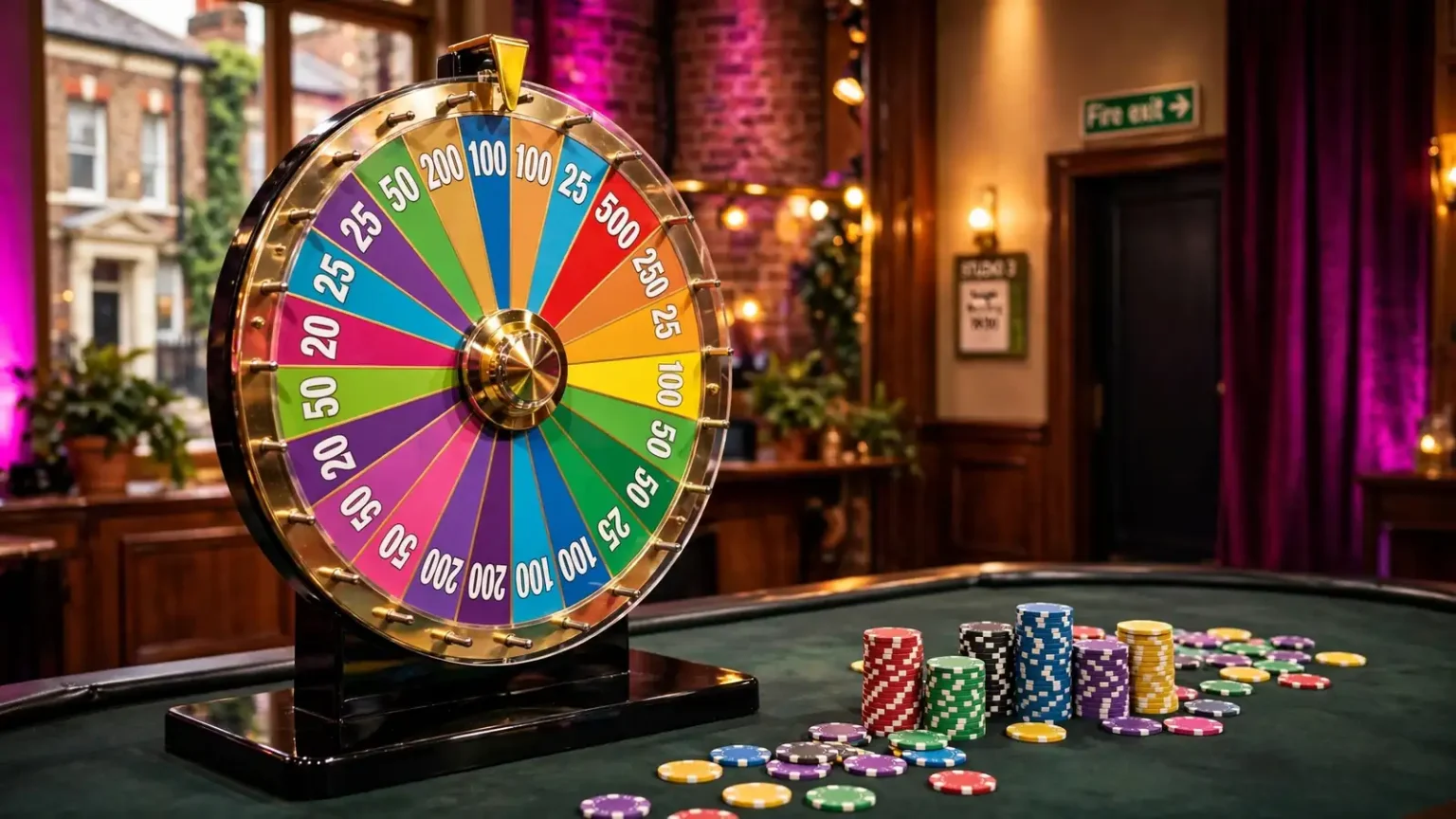
Crazy Time pairs a live studio feed with separate casino controls, so the streamed action and the betting interface serve different roles.
How Crazy Time Fits into an Online Casino
Crazy Time online casino play sits between two visible parts of the experience: a video stream showing a live studio and an on-screen interface for placing bets. The stream carries the real-time action, while the interface is where a player selects a wager and sees the available controls. They share a screen, but they do different jobs.
That distinction matters. A live casino game is not simply a digital animation dressed up to look like a studio. Its gameplay is streamed from a studio where a human dealer is present, and bets are submitted through the casino’s interface. The player watches events unfold as they happen rather than asking a purely digital game to generate and display an outcome on the same screen.
In practice, the casino page acts as the doorway. A player opening Crazy Time through an online casino would encounter it within that casino’s digital environment, not by walking up to a physical table. The exact page design and controls depend on the platform. The broad arrangement, however, is recognisable across live dealer games: a video area for the streamed table and a separate betting area that presents the choices and accepts selections.
Choosing a venue for Crazy Time is about finding a casino that fits your preferences for playing the live game show. Use these verdicts as a quick reference when considering the listed operators.
1. Zombillion
Payout speed: 1-3 business days
Zombillion lists a payout speed of 1–3 business days, a useful detail to consider when choosing where to play.
2. SlotoSport
Payout speed: 1-3 business days
SlotoSport lists a payout speed of 1–3 business days. That gives you a stated timeframe to bear in mind.
3. Dieselwin
Payout speed: 1-3 business days
Dieselwin’s listed payout speed is 1–3 business days, providing a clear point of reference for players.
4. WinBeast
Payout speed: 1-3 business days
WinBeast lists payouts as taking 1–3 business days. Consider this stated timeframe when evaluating the casino.
5. Britsino
Payout speed: 1-3 business days
Britsino has a listed payout speed of 1–3 business days, which is the available practical detail for this verdict.
6. Revery Play
Payout speed: 1-3 business days
Revery Play lists a payout speed of 1–3 business days. This gives readers a specific payment detail to consider.
7. NightLuck
Payout speed: 1-3 business days
NightLuck’s listed payout speed is 1–3 business days. Keep that timeframe in mind when considering the operator.
8. NightWin
Payout speed: 1-3 business days
NightWin lists payouts as taking 1–3 business days, offering a concrete detail for players to note.
9. BeOnBet
Payout speed: 1-3 business days
BeOnBet lists a payout speed of 1–3 business days. This stated timeframe is the available detail to guide your consideration.
10. Chanze
Payout speed: 1-3 business days
Chanze lists a payout speed of 1–3 business days, giving readers a specific payment-related point of reference.
I find it useful to think of those areas as two layers. The video layer makes the game observable; the interface layer makes participation possible. A stream can be running while the player is considering a wager, and the interface can show the selected option without changing the fact that the underlying play is happening in real time. That separation is one reason live casino pages can feel different from ordinary digital games, where the animation and the controls are usually part of one software experience.
The interface is more than decoration around a video. It is the practical link between the player and the live game. A selection has to be made there, and the player needs to be able to read the available controls while following the stream. Labels, buttons and on-screen information therefore affect how the experience feels, even though they do not turn the live feed into a digital simulation. When an interface is busy, the screen can demand attention in two places at once. When it is clear, the relationship between what is happening on camera and what can be selected is easier to follow.
This also changes the pace. Live games move more slowly than digital versions, because play takes place in real time rather than being produced entirely by software. A pause in the stream is not the same as a loading animation in a digital game: the player is watching a live setting, while the betting controls remain part of the casino page. The difference is structural, not just visual. A studio feed and an interface have to work together.
That arrangement depends on a stable internet connection. The video must arrive clearly enough to follow, and the betting interface must remain usable alongside it. If either side is disrupted, the experience can become harder to track. This is not unique to one title; it is part of the practical cost of choosing live play over a game that runs wholly on a device.
Minimum bets are another point of difference. Live games have higher minimum bets than digital versions, so the format can ask for a different starting commitment. That is worth understanding before treating a live table as merely another screen in a casino lobby. The central difference is not only the appearance of a human dealer. It is the way real-time streaming, interface controls and table conditions shape the session.
Deal or No Deal Casino UK: How the Game Works
The phrase “online casino Crazy Time” can make the game sound like a standalone app or a separate online destination. More accurately, it describes a live game encountered within an online casino environment. The casino supplies the page and the betting interface; the live component supplies the streamed studio gameplay. The player’s screen joins those elements, but does not erase the distinction between them.
I would not infer specific rules or visual features from that general setup. The fact that a game is presented as a live casino title tells us about the delivery method: real-time studio play, a human dealer and bets made through an on-screen interface. It does not, by itself, establish what every round contains or how a particular game’s selections work. Those details belong to the title’s own displayed information.
The useful starting point is therefore a simple one: Crazy Time, when accessed as a live casino game, is experienced through a stream and a betting interface working side by side. It is online access to a live setting, not proof that every part of the game behaves like a conventional digital product. The screen makes the connection. The format remains live.
The Casino Game Show Format, Without the Hype
A live casino game show combines a streamed studio broadcast with a betting interface. The gameplay happens in real time in a studio, where a human dealer leads the session. Players watch that feed and submit bets through controls shown on screen. The broadcast and the interface serve different purposes: one presents the action, while the other records the player’s choices.
That distinction is easy to lose in promotional language. “Live” describes the source and timing of the gameplay; it does not mean that a player is physically at the studio table. Nor does a presenter’s lively delivery change how the betting works. The dealer conducts the game on camera, while each participant uses the digital interface to take part remotely.
Crash Casino Games in the UK: How They Work
I find it useful to separate the show from the mechanism. The show is what appears in the stream: a dealer, a studio setting and the progress of a round. The mechanism is the system through which a bet is placed and associated with that round. They are presented together, but they are not the same thing. A polished broadcast can make the experience feel like a television event; the interface remains the point at which a player’s decision is entered.
For anyone looking at Crazy Time as a live casino game show in the UK, that is the reliable starting point. The broad live-dealer format involves a real-time studio feed, a human dealer and bets placed through an on-screen interface. That description does not establish the rules, rounds or features of any particular game. Those details belong to the game’s own information and should not be inferred from the general format.
The interface is more than decoration around the video. It is where the player indicates a choice, and where the available betting options are represented. The stream shows the studio action; the controls connect a participant’s selection to the game. In practice, the player is moving between watching and acting: following what is happening, then using the interface to make a decision. The visual presentation may encourage a sense of participation, but the player is still interacting through software rather than speaking to the dealer across a table.
That difference also explains why “interactive” needs careful reading. A human dealer is present in the studio and conducts the game in real time. The player’s bet, however, is communicated electronically. A live broadcast can create a shared event around the table, but it does not turn remote participation into a face-to-face exchange. The dealer’s role and the player’s role remain distinct.
I would not treat the phrase “game show” as a description of odds or a promise of entertainment value. It describes the presentation style: gameplay delivered as a studio broadcast, often with the visible presence of a host or dealer. Whether the format feels engaging is subjective. The more useful point is that the stream gives the game a human and visual setting, while the betting interface remains the practical channel for participation.
Do
- Treat the studio feed as the source of live action
- Use the digital interface to record your betting choice
- Keep the boundary between watching and acting clear
Don’t
- Confuse watching the dealer with placing a wager
- Assume the broadcast represents the betting mechanism
- Collapse the live stream and the bet into one act
This is also why viewing the broadcast and placing a bet should not be mentally collapsed into one act. Watching the dealer is not itself a wager. The wager is the selection made through the screen controls. That may sound obvious, but a busy presentation can draw attention away from the boundary between the two. I prefer to keep that boundary clear: the studio supplies the live action; the interface records the betting choice.
There is no need to assume that every live casino game show uses the same structure simply because it shares this format. A human dealer and real-time studio stream identify the broad category, not the specific mechanics of a named title. For Crazy Time, the game’s own rules and on-screen information are the place to establish what happens in play. The general format alone cannot answer that.
In short, a live casino game show is a remote, streamed experience built around a human-led studio game and digital betting controls. The broadcast supplies the scene; the interface carries the decision. Keep those roles separate.
Why “Slot” Searches Can Mislead
A casino search can attach the word “slot” to almost any game people expect to find in a casino. That label is not a reliable description of how play works. A slot is a digital game played through spins; a live-dealer game show is streamed from a studio, with a human dealer and bets placed through an on-screen interface. The screen may look lively in both cases. The underlying format is different.
Casino Dice Games in the UK: How They Work
I have seen search language flatten those distinctions. Someone looking for Crazy Time casino sites may mean a place where a live game show is available, while another person may be looking for a slot with a similar name or theme. The phrase alone does not establish which product is meant, what rules apply, or whether the game is offered at a particular casino. A site list built around the wording would not settle those questions.
Nor does calling something a “slot” make it one. The British rules for online slot spins are specific: a spin must last at least two and a half seconds, and autoplay is banned. Those restrictions concern online slots, not every casino game displayed on a screen. Treating the categories as interchangeable can lead to the wrong expectations about pace and how a round is played.
There is also a separate stake cap for online slots in Britain. It is five pounds per game cycle for customers aged twenty-five and over, and two pounds for customers aged eighteen to twenty-four. These are rules for slot play, not general limits that can be applied to every live table or game-show format. The distinction matters when a page uses “slot” loosely as shorthand for casino entertainment.
Searches for the best Crazy Time casino sites, or for a casino’s scores, can carry the same ambiguity. “Best” is a judgement, not a description of the product. A score may be a site rating, a game result, or a figure used by a particular page; those meanings are not interchangeable. Without a clear explanation of what is being measured, a score does not tell much about the live experience or the rules. It is a label, not evidence.
Legal Stakes
British rules for online slots include specific stake caps based on age, but these do not apply to every live table or game-show format.
The same caution applies when people look for Crazy Time casino strategies. A search term cannot establish that a game follows slot mechanics or that an approach designed for slot spins applies to a live game show. Strategy claims belong to the actual rules and outcomes of the particular game; the word “casino” is not enough to connect them. That question deserves its own treatment, rather than being answered by borrowing advice from an unrelated format.
I would read the product description before relying on the category printed beside a game. Look for whether play is described as a live stream with a dealer or as digital slot spins, and whether the rules identify the relevant format. That small check prevents a familiar mistake: assuming that every animated casino screen behaves like a slot.
The boundary is practical, not cosmetic. Slot regulation governs slot spins; a live-dealer game belongs to a different format. Search wording can blur the line. The rules do not.
Where Live Casino Play Is Legally Available
The legal starting point for live casino play in the UK is the operator’s licence, not the location of its studio or the branding around a game. A casino offering real-money live-dealer games to UK customers must hold the relevant operating licence from the UK Gambling Commission. That requirement applies to operators selling into the British market even when the business is based elsewhere.
This is the practical test behind phrases such as “available in the UK”. A site may load, display a live game or accept registration, but access alone does not establish that the operator is authorised to serve UK players. Nor does a familiar game name establish anything about the legal standing of the casino offering it. The licence belongs to the operator; it is not conferred by the game, the studio or the dealer.
Mines Casino Game in the UK: How It Works
I have seen the distinction matter in how offers are presented. Advertising tends to put the game first because that is what catches the eye. The regulatory condition sits further back, in the operator’s identity and legal information. That is less glamorous, but it is the part that determines whether the service is operating within the UK framework.
A foreign address does not, by itself, remove the licensing requirement. Remote operators serving British customers need the appropriate UK Gambling Commission licence. A site operating under a foreign authorisation alone is outside that UK regulatory system; it should not be treated as a lawful UK casino merely because its pages are accessible.
Age is a separate gate. Online gambling in the UK is for adults aged eighteen and over, and an operator must verify a customer’s age before allowing a deposit into a gambling account. Registration is therefore not the same as permission to fund play. The check is a condition of access to real-money gambling, rather than a formality to be left until after deposits have been made.
That distinction also affects how the process should be understood. A person may encounter a site before completing its checks, but the operator cannot properly allow funds to be deposited until age has been verified. If a service presents payment as available without that verification, that is not a shortcut that changes the rule.
For anyone considering where to play a live casino game, the relevant questions are plain: is the operator licensed by the UK Gambling Commission for the service it provides, and has the required age check been completed before depositing? These are conditions of lawful access, not quality ratings. A licence does not promise a particular experience or outcome. It establishes the regulatory basis on which the operator may serve the market.
Lawful Access Check
- Verify the operator holds a UK Gambling Commission licence
- Confirm the operator is authorised to serve UK customers
- Complete the mandatory age verification check
- Ensure a deposit is made only after age verification
The distinction is simple. A game can be visible; the operator still needs authority.
What Makes a Casino a Suitable Place to Play
A suitable place to play is not simply one with a prominent Crazy Time page. The practical test is whether the live table’s pace, minimum stake and technical demands fit the way the session is meant to work. Those details shape the experience more directly than promotional language does.
Live play moves more slowly than a digital version. A dealer-led table has to progress in real time, so there is less scope to move immediately from one round to the next. I treat that pace as a basic condition, not a flaw: it may suit someone who wants to follow a live table, but it can feel restrictive to someone expecting rapid, uninterrupted play. The important point is to understand the rhythm before treating a session as interchangeable with a faster digital game.
Minimum bets also affect whether a table is suitable. A specialist review has reported that some live roulette and baccarat tables begin at 20p, while blackjack tables can have higher entry stakes. That is a reported snapshot, not a dependable market-wide rule. Limits vary between tables and can change, so the amount shown on the selected table is more useful than an old review or a general claim about what casinos offer. The lowest available stake matters because it sets the cost of taking part in each round; it does not indicate how favourable the game is.
Connection quality is another practical constraint. Live video needs a stable internet connection. If the stream repeatedly stalls or falls out of step with the betting interface, it becomes harder to follow the table and make decisions calmly. A casino environment that works well on a strong connection may be frustrating on an unreliable one. I would assess the actual stream and interface under the conditions in which play is likely to take place, rather than assume that a polished page guarantees a smooth session.
The interface should make the current table limits and the point at which betting closes easy to identify. Clear presentation reduces avoidable confusion; it does not change the game’s outcomes. The same applies to a visible history of previous rounds: it can help explain what has happened, but it should not be mistaken for a forecast of what comes next.
Chicken Road Game Casino UK: What to Know
A good fit is therefore personal and operational, not a ranking. The table should be comfortable to follow, its minimum should fit the planned budget, and the connection should support the live stream without disruption. Before starting, I set a budget and keep it separate from any expectation that a particular result will arrive. If the pace or stake does not suit, the sensible choice is not to force the session.
No perfect setup.
Strategy Claims, House Edges and Limits
A “strategy” can mean two quite different things in casino copy. It may describe a decision that changes how a game is played, or it may be a staking pattern that changes the size and timing of bets. The distinction matters. A betting pattern can organise a bankroll; it cannot make an unfavourable game favourable or guarantee a particular result.
For Crazy Time, claims about a casino strategy should be treated cautiously when they rely on supposed patterns in past outcomes. A tracker can record what has happened, but a record is not a forecast. Previous results do not influence future spins or Lightning Numbers. A history chart may look persuasive because it gives a sequence visual shape; that does not establish that the next result is due to follow it.
This is where staking systems are often dressed up as “control”. Martingale, for instance, involves increasing a stake after a loss in an attempt to recover earlier losses when a win arrives. The arithmetic sounds tidy until a losing run requires progressively larger bets. Blackjack retains a house edge, and Martingale can still result in losses. The principle is not specific to blackjack: changing stake size does not erase the underlying terms of a game.
Blackjack is a useful example precisely because it has player decisions, unlike a staking plan that merely changes the amount risked. Its aim is to finish with a hand worth 21 points, or closer to that total than the dealer, without going over. Even where choices affect play, the game retains a house edge. That example should not be taken as a description of Crazy Time’s mechanics; the games are different, and a blackjack tactic cannot be carried across by relabelling it.
Live Dream Catcher Casino UK: What to Check
“Casino history” can also be used to imply that a record reveals a system. In practice, a history is a description of earlier events. It may help someone keep notes on their own play, but it does not show that an outcome is more likely because a particular sequence appeared before. A tracker is an accounting tool, not an advantage.
The same applies to plans built around recovering a loss. Once the original budget has been reached, raising stakes to get back to an earlier balance makes the exposure larger; it does not make recovery safer. Set a budget before playing and keep to it. Do not chase losses or winnings beyond that limit. No staking system changes that boundary.
I have seen neat progressions presented as if tidy arithmetic were the same thing as protection. It is not. The relevant question is not whether a sequence looks disciplined, but whether it changes the game’s edge. A staking pattern does not. This is entertainment, not gambling advice.
Demo Play and What It Cannot Prove
A Crazy Time casino demo, where an operator makes one available, can help show how a game is presented on screen. It may give a sense of where controls sit and how a session is organised. That is a limited form of familiarisation, not a preview of what a real-money session will produce.
The distinction matters because a demo does not establish that its results predict later outcomes. A run of favourable or unfavourable results in free practice says nothing reliable about what will happen in another session. Treating a short demo as evidence of a pattern is a mistake I have seen turn casual testing into misplaced confidence.
Nor does a demo provide a route to cash winnings. Any play that is explicitly free should not be represented as generating real payouts. A demonstration can illustrate a presentation; it cannot prove that the same experience will feel identical when money is at stake. The decision pressure changes. That is the part a screen cannot rehearse.
Attention A demo session is for familiarisation and entertainment; it cannot guarantee future results or serve as a source of income.
A demo is also a poor basis for comparing casinos or declaring one the “top” place to play. A sample may reveal something about the layout or pacing, but it cannot settle wider questions about the live-casino environment. A polished demonstration is not proof of better conditions, and a disappointing one is not a forecast of future results. The label is not a verdict.
The same limit applies to “tips” gathered from free sessions. Practice can help someone understand what appears on screen, but it cannot validate a betting method or make an outcome more predictable. That belongs to a different question from learning the interface. Confusing the two gives a demo more authority than it has.
I use a simple test: ask what a practice session can actually show. It can show the version of the interface being demonstrated at that moment. It cannot guarantee future results, establish a reliable pattern, or turn play without real stakes into evidence of real-money returns. If the aim is to check basic navigation, the demo may be useful. If the aim is to forecast winnings, it is not.
Keep the boundary clear. A free demonstration is for familiarisation and entertainment, not a source of income or gambling advice. Its strongest claim is modest: it may help make the screen less unfamiliar. Nothing more.
Free Play, Bonuses and the Difference Between Them
“Free” can describe different things, and the distinction matters. A free-play version of a casino game is for entertainment: it does not provide a route to cash payouts. It can show how a game feels to use, but a balance displayed in that setting is not money that can be withdrawn. The label describes the play mode, not a promise of value.
A bonus is different. It is an offer attached to an account or deposit, and its conditions determine how it can be used. Calling an offer “free” does not mean every game is eligible, or that the balance can be treated like cash. The wording on the offer needs to be read alongside its terms.
The common mismatch is between slot free spins and a live table. A specialist review reports that most UK welcome offers are free spins for slots, which cannot be used at live tables. That distinction is practical, not cosmetic: a spin offer is tied to eligible slot play, while a live casino table has its own betting interface and does not become eligible merely because both sit within the same online casino.
So a search for Crazy Time free spins may point towards an offer that has no use for the live game. “Free spins” is not a general credit for any casino product. The eligible games and any restrictions are set out in the offer terms. If the offer names slots, it should not be assumed to cover a live game show.
I have seen “free” do too much work in promotional copy. It can mean a no-cost play mode, a limited offer with conditions, or simply a feature that sounds generous before the restrictions are read. Those are not interchangeable.
For a Crazy Time review, the useful question is what the particular free label actually grants: practice without real payouts, or an offer with defined eligible games and conditions. A review that treats free play as a way to win withdrawable money blurs an important line. Free practice is not a cash offer. Slot spins are not live-table credit. And neither label, by itself, establishes whether a casino is safe.
Slot free spins are typically tied to eligible slot play and cannot be used at live casino tables.
GamStop Searches and the UK Licence Question
The phrase “not on GamStop” can sound like a useful way to identify a different kind of casino. It does not answer the more important question for a British player: whether the operator is authorised to offer gambling here. A site’s description of its relationship with GamStop is not a substitute for a UK Gambling Commission licence.
That distinction matters when a search for Crazy Time leads to a casino promoted as outside GamStop. The game name, a live studio presentation or a prominent “UK” label does not establish that the operator may legally serve customers in Britain. For legal live-dealer gambling in the UK, the casino must hold a UK Gambling Commission licence. Remote operators selling into the British market need the relevant licence regardless of where they are based.
I have found it useful to treat “not on GamStop” as a description, not a credential. It does not, by itself, confirm who runs the site, what regulatory system applies or whether the operator is licensed for the British market. Nor does the presence of a familiar game title settle those questions. The licence is the relevant test.
There is a separate point about the wording “Crazy Time Evolution casino”. A game or studio association in a search result should not be read as proof that a particular casino is an official venue or is licensed in the UK. The legal status belongs to the gambling operator, not to the game name used to attract attention.
This is where promotional language can blur categories. “Alternative access” may sound like a harmless convenience, but it says nothing conclusive about UK authorisation. I would not treat absence from a particular scheme as evidence of permission to offer gambling. The test remains the operator’s UK Gambling Commission licence.
For a British audience, that is the practical distinction: a casino described as outside GamStop is not automatically a legal UK live-casino option. Where the operator lacks the required UK licence, the “not on GamStop” label does not make it one. Short label. Different question.
Live Casino Bonuses: The Terms Behind the Offer
A Crazy Time casino bonus can look relevant because it appears beside a live game, but placement is not the same as eligibility. The terms determine whether live play counts towards the wagering requirement, and how much each qualifying bet contributes. Live games often receive only a small share of that contribution; a stated 10% weighting, for instance, means only a fraction of qualifying stakes is credited. The rest of the requirement does not disappear.
That distinction matters for welcome and deposit offers, and for any promotion described as a no-deposit bonus. The label says little about whether a particular live table qualifies. The offer rules need to identify eligible games and explain the weighting applied to them. If the live game is excluded, or contributes less than other game categories, playing it may do little to clear the requirement.
I have seen the headline amount do most of the selling while the qualifying conditions do the actual work. “Bonus” is not the same as withdrawable cash. The terms may set a wagering requirement, a maximum bet while the offer is active, or restrictions on which games count. Those conditions affect what can be withdrawn and when; the promotional banner alone cannot answer that.
For a Crazy Time casino bonus in the UK, the useful comparison is therefore not just the advertised value. It is the contribution assigned to live games, the games permitted, any maximum-bet condition, and the steps needed before a balance becomes withdrawable. A bonus with low live-game weighting can have limited practical value for someone intending to play mainly at a live table.
No special payout follows from using a bonus, and a promotion does not change the underlying game outcomes. The published rules are the working document; the headline is the sales copy. This is entertainment content, not gambling advice. No bonus removes the risk of losing money.
How do you play live roulette?
Choose a bet through the on-screen interface and watch the dealer spin a physical wheel. You win if the ball lands on a number covered by your bet.
How do you choose a live dealer casino?
In the UK, choose a casino that holds a UK Gambling Commission licence.
What are the different types of roulette you can play with a live dealer?
Common types include European, American and French roulette. European roulette has one green zero pocket, while American roulette has both 0 and 00; in French roulette, an even-money bet loses only half if the ball lands on zero.
Material created by the team Golden Mister