
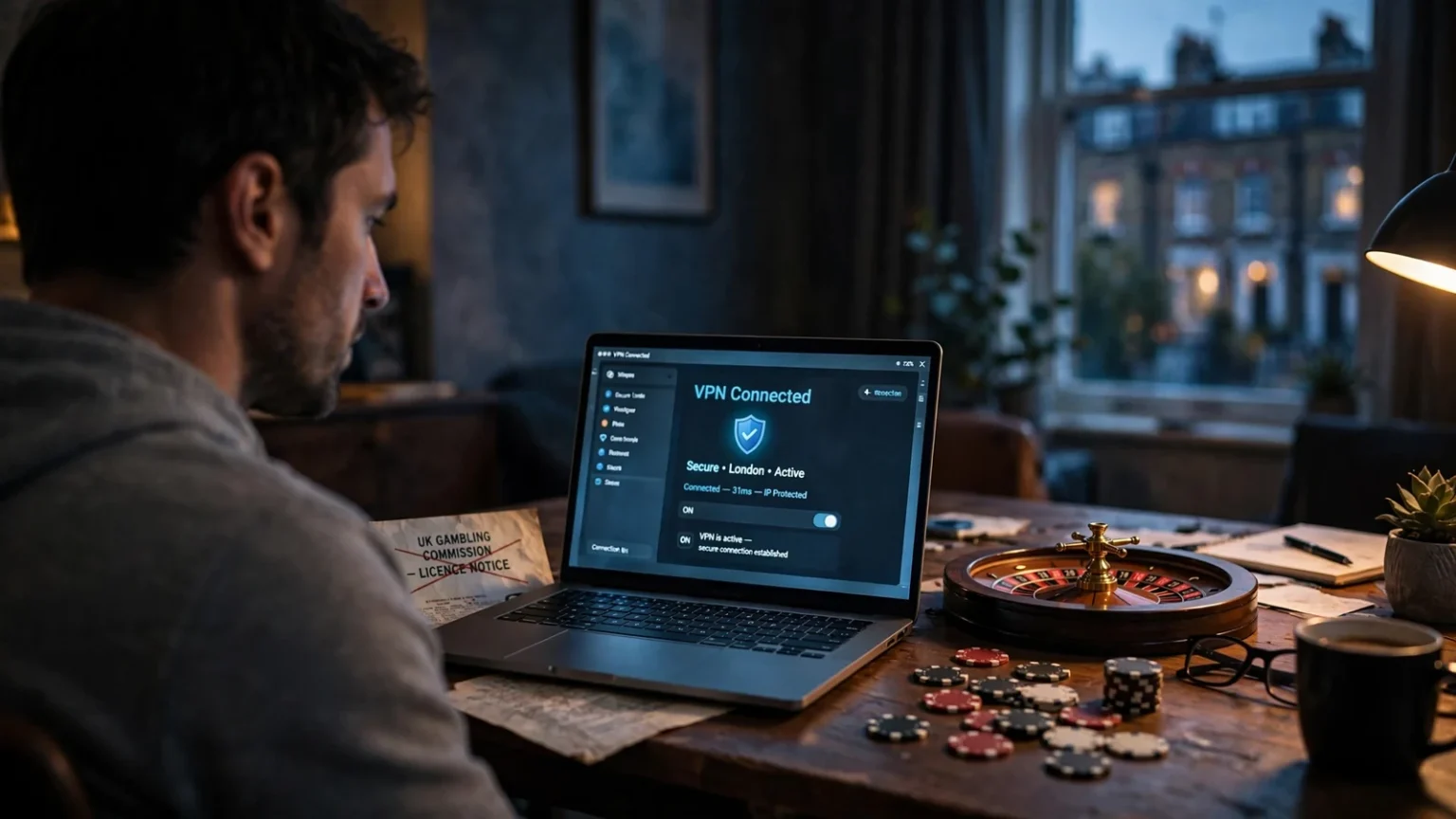
VPN access describes how a site handles connections, not its licence or level of oversight.
Where VPN-Friendly Casinos Sit in the UK Market
VPN-friendly casinos occupy a distinct part of the online gambling market: they are mostly offshore operators, rather than businesses licensed by the UK Gambling Commission. Their licences may come from jurisdictions such as Curaçao, the Isle of Man or Malta. That geography matters because a licence issued elsewhere does not, by itself, place an operator inside the British regulatory system.
The phrase “VPN-friendly” describes a site’s approach to connections made through virtual private networks. It does not identify a particular licence, corporate structure or level of oversight. In the market, the label is commonly associated with offshore casinos because their operating arrangements differ from those of UKGC-licensed businesses. The label is about access in the broad sense, not a regulatory category.
The boundary is clearer when the location of the operator is separated from the market it serves. The UK Gambling Commission regulates remote gambling offered to consumers in Great Britain, even when the equipment that runs the service is located elsewhere. A business does not move outside the Commission’s reach simply by hosting its platform abroad. The relevant issue is whether it offers remote gambling to people in Great Britain.
That distinction can be obscured by a foreign licence displayed on a casino site. A licence from Curaçao, the Isle of Man or Malta belongs to the issuing jurisdiction’s framework; it is not a UKGC licence. Offshore operators sit outside the UKGC system when they are not licensed by the Commission. Their appearance in the same online market as British-facing businesses does not make their regulatory status equivalent.
From inside the industry, I have found that the word “licensed” can do a lot of work in a banner or footer while saying little about which regulator is responsible. The jurisdiction is the useful detail. It identifies the authority that issued the licence, but it does not answer whether an operator holds the permission required to offer remote gambling to consumers in Great Britain. Those are separate questions.
Anjouan Casino Licence and UK Market Access
The distinction also explains why “VPN casino” is not a reliable shorthand for one type of business. It may refer to an offshore casino that accepts VPN connections, but the phrase does not establish where the operator is incorporated, where it is licensed, or which market it is legally authorised to serve. A platform can be technically accessible from one place while remaining outside that place’s regulatory framework. Access and authorisation are different matters.
Great Britain’s system is built around the activity offered to consumers, not merely the server room or company address. The Commission’s role covers remote gambling offered in Great Britain regardless of where the key equipment sits. As a result, an offshore location is not, on its own, an exemption from British regulation for an operator targeting that market. Conversely, a casino’s foreign licence does not become British oversight simply because a person in Britain can reach its website.
This is why offshore and UKGC-licensed should not be treated as interchangeable descriptions. The first points to an operator’s position outside the Commission’s licensing system; the second identifies businesses operating under that system. A site may present itself as international, and its licence may come from a recognised gambling jurisdiction, but neither phrase changes the regulator responsible for the British market.
The market’s mixed terminology can make the category seem more settled than it is. “VPN-friendly” sounds like a formal status, yet it describes a connection policy, not a legal classification. “Offshore” describes the operator’s regulatory position relative to the UKGC, while Curaçao, the Isle of Man and Malta identify licensing jurisdictions found among these businesses. Keeping those descriptions apart prevents a connection feature from being mistaken for regulatory protection.
The broad picture, then, is a British market with a defined domestic regulator and a visible offshore segment operating under other jurisdictions’ licences. The UK Gambling Commission’s reach over remote gambling offered to Great Britain consumers is not determined by where an operator places its technology. The offshore label explains where a business sits in relation to that system; it does not confer UKGC status. Different frameworks. Different responsibilities.
What “Best” Means When No Operator List Is Verified
VPN access can depend on a casino’s terms and location checks, so confirm the rules before signing up. The details available here are limited to payout speed and do not establish whether any operator permits VPN use.
1. Zombillion
Payout speed: 1-3 business days
Zombillion lists a payout speed of 1–3 business days. No information is provided here about its VPN policy.
2. SlotoSport
Payout speed: 1-3 business days
SlotoSport lists a payout speed of 1–3 business days. Its VPN policy is not specified in the available details.
3. Dieselwin
Payout speed: 1-3 business days
Dieselwin lists a payout speed of 1–3 business days. The information provided does not say whether VPN use is permitted.
4. WinBeast
Payout speed: 1-3 business days
WinBeast lists a payout speed of 1–3 business days. No VPN-use details are available here.
5. Britsino
Payout speed: 1-3 business days
Britsino lists a payout speed of 1–3 business days. Its VPN policy is not given in the available information.
6. Revery Play
Payout speed: 1-3 business days
Revery Play lists a payout speed of 1–3 business days. The supplied details do not establish whether it allows VPN use.
7. NightLuck
Payout speed: 1-3 business days
NightLuck lists a payout speed of 1–3 business days. No information about its VPN policy is provided.
8. NightWin
Payout speed: 1-3 business days
NightWin lists a payout speed of 1–3 business days. The available details do not specify its rules on VPN use.
9. BeOnBet
Payout speed: 1-3 business days
BeOnBet lists a payout speed of 1–3 business days. Its VPN policy is not stated in the information provided.
10. Chanze
Payout speed: 1-3 business days
Chanze lists a payout speed of 1–3 business days. No details are available here about whether VPN use is permitted.
“Best” is an advertising word, not a measure of how an account will work when money is involved. In the VPN-friendly casino market, the label can refer to a site that accepts VPN connections, offers cryptocurrency, displays a large welcome bonus or promotes a broad games catalogue. Each may be appealing on its own. None, by itself, establishes that the terms are favourable or that the protections match those at a UKGC-licensed operator.
I have seen how a headline offer is built to catch the eye: the most visible figure sits upfront, while the conditions that govern its value sit behind a link. A bonus is not cash with a different name. Wagering requirements determine how much qualifying play must take place before bonus-related funds can be withdrawn, and the rule may apply to the bonus, the deposit or both. The precise wording matters more than the size of the headline.
Attention: A large welcome bonus can look generous, but high wagering requirements may make it difficult to turn those funds into withdrawable cash.
There is also no single figure that can be treated as a settled standard for offshore offers. One specialist review reports welcome-bonus wagering requirements of 30x, 40x or 50x; other reporting says offshore casinos can set them as high as 60x. That disagreement is a reason to read the offer attached to the particular account, not to assume that any one multiplier describes the market. A large bonus can look generous while its conditions make it difficult to turn into withdrawable funds.
Separate the pitch from the terms
A useful assessment starts by separating what the site advertises from what its rules commit it to do. “Fast withdrawals” sounds decisive, but it is only meaningful when the terms explain how a withdrawal is approved and what can delay it. “Crypto-friendly” describes a payment option, not the quality of a casino’s rules. “VPN-friendly” describes a connection policy, not a guarantee that an account will remain open or that a withdrawal will be accepted.
The same distinction applies to claims about choice, convenience and flexibility. A polished lobby or a prominent bonus may make a site appear competitive; neither tells much about dispute handling, account restrictions or the conditions attached to funds. The detail is usually in several separate documents: bonus rules, payment terms, account terms and privacy notices. Read together, they show whether the headline promise survives contact with the operating rules.
Non-GamStop European Casinos: UK Exclusion Rules
From the other side of the counter, I learned that a condition is rarely decorative. It allocates discretion and defines when the operator can pause or refuse a transaction. A clear term is easier to evaluate than a sweeping promise, even if the promise sounds more attractive.
What “best” can reasonably mean
For a VPN-friendly casino, “best” is best treated as a set of questions rather than a trophy. Is the connection policy stated plainly? Are the bonus conditions readable before registration? Do payment rules explain how withdrawals are handled? Are restrictions on countries, accounts or promotions explicit? These questions do not produce a universal winner, but they distinguish a specific operating commitment from a marketing adjective.
A casino can appear attractive because it accepts a VPN connection and supports crypto. That combination may suit someone looking for a particular way to access games or move funds. It does not, however, demonstrate that the operator provides the same safeguards as a UKGC-licensed casino. Nor does an attractive interface settle what happens when identity, account eligibility or a disputed balance becomes an issue. The appearance of flexibility is not the same as a dependable remedy.
Do
- Check if the connection policy is stated plainly
- Read bonus conditions before registration
- Verify if payment rules explain withdrawal handling
- Look for explicit restrictions on accounts and promotions
Don’t
- Assume a VPN-friendly label guarantees safeguards
- Mistake an attractive interface for a dependable remedy
- Treat the appearance of flexibility as a guarantee
- Confuse a connection policy with regulatory protection
Bonuses deserve especially careful reading because the visible reward and the qualifying conditions work together. The stated wagering multiple is only one part of the calculation: the terms may also specify which games count, how long the offer remains active and what happens if a rule is breached. If those details are unclear, the headline value cannot be assessed on its own. A bigger offer is not automatically a better one.
A practical reading of “best”
I would put more weight on precise, consistent terms than on enthusiastic labels. A useful offer explains its restrictions in language that can be checked against the account and payment rules. A weak one leaves key points broad or scattered, making it hard to tell what the operator has actually promised.
That does not turn a comparison into a guarantee. Offshore operators set their own rules, and the conditions that make a site appealing to one player may be a poor fit for another. “Best” therefore describes a judgement about stated features, not a verified assurance about every future account outcome. The distinction is plain. Advertising sells the impression; terms govern the transaction.
What a VPN Changes—and What It Does Not
A VPN changes the network address a gambling site sees. Instead of receiving the connection directly from the player’s internet service provider, the site sees an address associated with the VPN network through which the traffic is routed. When that network is outside the UK, the apparent IP location may also appear to be outside the UK.
Jackpot Mobile Casinos in the UK: How They Work
That change is narrower than it can sound. The IP address is one piece of connection information; it is not proof of identity, age, residence or eligibility to hold an account. A VPN changes how the connection is presented at the network level. It does not turn one person into another, or make identity checks disappear.
IP location is not the same as identity
I have seen these two processes treated as if they were interchangeable, particularly in marketing language around a “VPN-friendly” casino. They are not. A casino can see a connection arriving through a VPN and still ask for information to establish who owns the account. Know-your-customer checks, often shortened to KYC, are a separate process from recognising an IP address.
This distinction matters because an IP address can suggest where a connection is coming from without establishing who is using it. Conversely, identity verification does not necessarily tell a site what route the current internet connection has taken. The two questions are different: what network address is visible, and who is the account holder?
A VPN therefore does not supply identity documents or complete account verification. Nor does a change in apparent location amount to approval of an account. The connection and the person are assessed through different mechanisms.
Why access may change
Internet service providers can restrict access to particular sites. A VPN may get around an ISP-level restriction by masking the original IP address and routing the connection through a network outside the UK. From the site’s perspective, the incoming address is then the VPN network’s address rather than the player’s ordinary connection address.
That can change whether a page loads through a particular route. It does not mean the casino itself has changed its requirements, or that the account has passed any checks. The network path has changed; the underlying account has not.
Non-UK-Regulated Casinos: Licences and Risks
The distinction is easy to lose in a short promotional description. “Access” can mean that a site opens in a browser, while an account decision involves separate checks. One is a connection outcome. The other is an operator’s assessment. They are not the same result.
Why the connection may still be blocked
A VPN does not guarantee that a casino will accept the connection. A UKGC-licensed casino may block a connection arriving from a VPN address, and changing the visible IP can therefore produce the opposite of the expected result: the site refuses the connection. The VPN has altered the address; it has not compelled the site to accept it.
The UKGC’s regulatory system also has a distinction between organisations and individuals. The Gambling Commission grants operating licences to businesses and personal licences to individuals who perform relevant roles in Great Britain. Those licences concern the people and businesses operating gambling services; they are not a substitute for checking an individual player’s identity.
In practical terms, the IP address is a routing clue, not a passport. It may affect how a website classifies a connection, but KYC remains a separate account process. A VPN can alter the first without completing the second.
This is the point that gets blurred by the phrase “change location.” A VPN changes the apparent network location associated with an IP address. It does not physically relocate the player, rewrite account information or settle the question of identity. The site may see a different route and still require its ordinary verification process.
From the operator side, the separation is deliberate. Connection data describes how a session reaches the site; identity checks concern the person behind the account. Treating one as a replacement for the other would confuse a technical signal with an account decision.
USA Casinos for UK Players: Licensing and Risks
Different mechanism. Different question.
Using a VPN at an Online Casino: The UK Trade-Off
The practical question is not just whether a casino page will load through a VPN. It is which rules govern the account once money is involved. UK law does not make it a criminal offence for a person in the UK to gamble online through a VPN. That does not turn every site accepting a connection into a UK-regulated casino, or give an offshore operator the duties that apply to a UKGC-licensed business.
I have seen those two points blur together in casino advertising. “VPN-friendly” describes a connection the site accepts; it is not a statement about UK oversight. An offshore casino may let a UK resident open or use an account, but playing there means losing the consumer protections attached to UKGC-regulated gambling. The distinction is material when a dispute concerns an account balance, a withdrawal or the operator’s interpretation of its own terms. Access is not protection.
The legal position of the player and the regulatory position of the operator are separate. A UK resident is not criminalised simply for using a VPN while gambling online. But operators offering real-money gambling to consumers in Great Britain are required to hold the relevant UK Gambling Commission licence. An offshore site outside that system does not acquire UKGC oversight merely because it accepts British customers or allows a VPN connection.
That gap shapes the trade-off. With a UKGC-licensed operator, location checks are part of the operator’s legal obligations. A VPN connection does not remove them, and it should not be treated as permission to conceal where an account is being used. If the location information available to the operator does not satisfy its checks, the connection may not proceed as expected. The operator’s verification duty remains its own.
Risk of Loss
If an operator treats a concealed location as a breach of terms, it may lead to account closure and the loss of all winnings.
Offshore terms create a different kind of uncertainty. The site may accept VPN connections in general while setting conditions about who may hold an account or where a customer may be based. A successful login does not settle whether the account complies with those terms. Where an operator treats concealed location as a breach, account closure and the loss of winnings may follow. That is a commercial and contractual risk, not evidence that the player has committed a UK criminal offence.
This is why “can I use a VPN?” has no single answer that covers both law and account rules. The use of a VPN for gambling is not itself criminalised, but the operator’s licence status and terms still matter. At a UKGC-licensed casino, location verification is mandatory; at an offshore casino, accepting the connection does not restore UK consumer protections. These are different arrangements, not interchangeable routes to the same safeguards.
From the operator side, a location check is not a cosmetic step. It forms part of the controls that determine whether the business can serve a customer under its regulatory obligations. A VPN may complicate the information the operator receives, but it does not transfer responsibility for those checks to the customer or make the operator’s duties disappear.
So the trade-off is not simply convenience against inconvenience. It is the difference between gambling within the UKGC framework and using an offshore service where that framework does not protect the account. Lawfulness for the player is not the same as regulatory protection. That distinction matters.
Crypto Payments, KYC and Withdrawal Timing
Payment choice changes the paperwork and the wait, but it does not make a casino’s checks disappear. In my experience, the useful distinction is between reducing friction at the deposit stage and getting a withdrawal approved. They are separate steps, handled under different checks.
Online Casino No Registration UK: How Play Works
Crypto deposits can mean fewer location checks and less KYC friction when the amount is small. That is a limited convenience, not anonymity. Casinos may still record device fingerprints, IP logs and browser data, creating a wider record of how an account connects and behaves. A crypto transaction therefore does not erase the information gathered by the casino or establish that an account will remain unchecked later.
The qualification matters. “Low-friction” describes a possible deposit experience; it does not promise that the same account can withdraw without documents. Some offshore casinos permit smaller withdrawals without first requesting paperwork, then require KYC once a higher withdrawal threshold is reached. The threshold and the point at which checks begin depend on the operator’s terms. Deposit method alone is not a reliable guide to what will be requested at cash-out.
The route affects the wait
Crypto can be quick after a withdrawal has been approved. A specialist review reports processing times from minutes to a few hours for crypto withdrawals at VPN-friendly casinos. That is a reported window, not a fixed service standard: processing can involve the casino as well as the payment network, and the review’s account should not be mistaken for a guarantee applying to every operator.
For fiat withdrawals, the available reporting is less uniform. One specialist review puts e-wallet or bank-transfer withdrawals in a range of one to five days, while describing e-wallet withdrawals as taking about a day. These are source-specific estimates, not a settled timetable across the market. Bank-card withdrawals are described as rare in that review, so card availability should not be assumed simply because a deposit by card was accepted.
Cryptocurrency
Processing times can range from minutes to a few hours after approval.
E-wallets
Withdrawals are reported to take approximately one day.
Bank Transfers
Processing times typically fall within a range of one to five days.
This difference reflects an operational detail that promotional payment pages tend to compress: depositing and withdrawing are not mirror-image transactions. A method may be offered for funding an account without being available for payouts, and the casino’s approval step sits before any payment provider’s own handling time. “Fast withdrawals” can therefore refer to only one part of the process.
What the payment label leaves out
A crypto payment may reduce friction for a small deposit, but the account can still be subject to identity checks and other review. A request for documents can delay a withdrawal regardless of whether the balance was built through crypto, an e-wallet or bank transfer. The advertised payment method does not settle the question of when those checks occur.
Fiat methods also involve different expectations. E-wallet reporting points to a shorter estimate than the broader bank-transfer range, while card payouts are reported as uncommon. Those distinctions are more useful than treating all non-crypto withdrawals as one category. Still, the timing claims should be read as descriptions from a specialist review, not as commitments made across VPN-friendly casinos.
In practice, payment speed has two clocks: the operator’s decision and the payment route’s processing. Crypto may move quickly once released; an e-wallet may have a shorter reported wait than a bank transfer. Neither removes the casino’s discretion to review an account. Small deposits can mean fewer checks at first. Not no checks.
How VPN-Friendly Casino Sites Handle Access
Casino sites do not all treat a VPN connection in the same way. Some reject connections identified as coming through a virtual private network; others allow access from at least some VPN connections. That distinction is what “VPN-friendly” describes: whether the site accepts the connection at the point of access. It does not, by itself, explain what the operator will allow once an account is opened or a withdrawal is requested.
At UKGC-licensed operators, VPN connections are commonly blocked. Offshore sites that accept VPN traffic therefore work differently at the access stage, but their policies are not uniform. One operator may permit connections in some circumstances while restricting others under its terms. Another may change its approach later. An access page or a successful visit is not a lasting promise.
That matters because the first screen is only one part of the operator’s decision-making. A site letting a connection through does not establish that every activity on the account meets its rules. The terms may set conditions around VPN use, and those conditions may be less visible than the access itself. “Allowed” can describe a narrow technical outcome, not blanket approval of a player’s circumstances.
Curacao casino licence in the UK: what it means
Policies can also change without notice. A casino that accepts a VPN connection today may later block it, or may review an account under revised conditions. There is no reliable inference from being able to load the site to being assured continued access. The distinction is simple. Access is not approval.
This is why broad labels such as “VPN-friendly” need careful reading. They can tell little about whether the operator’s permission is unconditional, how it treats accounts if its policy changes, or whether a particular connection will remain accepted. A statement on a site’s promotional material is not equivalent to a guarantee that all future access and account activity will be treated the same way.
The consequences can reach beyond a blocked page. If an operator considers VPN use to breach its terms, it may close the account and confiscate winnings. That risk is especially important where the rules are conditional or the operator’s position changes. A connection that worked previously does not settle a later dispute about compliance.
Offshore operators sit outside the UK Gambling Commission’s regulatory system and have no obligation to follow UK laws. Acceptance of VPN traffic should not be mistaken for UKGC oversight or for the protections attached to a UKGC-licensed operator. It only indicates that the site has not blocked that connection at that point.
A practical reading of any access statement is therefore narrow: it describes the operator’s current position on connections, subject to its terms and possible change. It does not promise that an account will remain open, that winnings will be paid, or that a customer has protection if the operator takes a different view. Those are separate questions, not answered by a site loading successfully.
Are VPNs Allowed at UK Casinos?
“Allowed” can mean two different things here: whether using a VPN is a criminal offence, and whether a casino accepts a connection routed through one. Those are not the same test. UK law does not criminalise using a VPN to gamble online, but that does not oblige an operator to permit VPN connections.
Most UKGC-licensed operators block them. From the operator’s side, a connection that obscures a player’s apparent location conflicts with the controls used to establish where a customer is playing. The practical result is a refused connection, even though the VPN itself is not prohibited by criminal law. Access and permission are separate matters.
Non-UK-Registered Casinos: How Regulation Works
The regulator’s role is broader than deciding how a website handles a particular connection. The UK Gambling Commission oversees gambling activity in the United Kingdom, including online casinos, and is the sole regulator for commercial gambling in Great Britain. It regulates operators; it does not make every technical method of connecting to a casino acceptable under that operator’s terms.
I have seen the word “allowed” do too much work in casino copy. A site may accept a VPN connection, but that describes its access policy, not an approval from the UK Gambling Commission. Nor does it mean a UKGC-licensed casino will accept the same connection. Operator rules differ, and acceptance at one site cannot be carried over to another.
So the short answer depends on the meaning. VPN use is not criminalised in itself, but most UKGC-licensed casinos block VPN connections. A VPN-friendly site’s willingness to accept one is a separate operator decision, not a change to the regulator’s remit. Not the same thing.
Bitcoin Withdrawals and the KYC Threshold
Bitcoin can make a withdrawal look simple: the casino sends cryptocurrency, and the payment is processed without the bank-transfer steps associated with fiat. But the speed of the transfer and the timing of identity checks are separate matters. A quick payment does not mean the account has cleared every verification stage.
A specialist review of VPN-friendly casinos gives a processing window of minutes to a few hours for crypto withdrawals. That is a reported timeframe, not a standing promise across operators or transactions. Bitcoin network conditions and the casino’s own handling are distinct parts of the process, and the reported window should not be read as a guaranteed arrival time.
The more consequential condition may appear at the withdrawal threshold. Some offshore casinos permit small withdrawals before requesting documents, then require KYC when a larger amount is reached. The threshold is often stated as £1,000 or its equivalent in cryptocurrency. “No documents for small withdrawals” is therefore a conditional feature, not an exemption from identity checks. The casino may ask for verification later, when the balance or requested withdrawal crosses its stated threshold.
From the operator’s side, that distinction is practical: payment can be released quickly while account checks remain available at a later stage. From the player’s side, it means a successful small Bitcoin withdrawal does not establish that a larger one will be handled without documentation. Thresholds and terms need to be read as account conditions, not inferred from an earlier payment.
Trusted UK Casino Guide: Licence, Checks and Terms
A VPN-friendly Bitcoin casino may advertise cryptocurrency as a faster route, but speed and verification are not interchangeable. The available timing report concerns crypto withdrawals generally; it does not establish a separate guaranteed timetable for Bitcoin at every site. Nor does using Bitcoin remove the possibility of KYC. Fast transfer. Separate check.
The Security Claim Behind a Casino VPN
A VPN’s strongest security argument is straightforward: it encrypts the internet connection, helping protect personal information from hackers or cybercriminals. That can matter when casino account details and other personal data pass between a device and an online service. The protection is about the connection, not a guarantee that every part of the gambling account is secure.
From the other side of the counter, I learned to treat “secure” as a narrow claim, not a general stamp of approval. Encryption does not establish that a casino is trustworthy, that its account controls are sound or that a player’s money is protected if a dispute arises. It cannot repair weak security at the operator’s end. Useful, but limited.
The same distinction applies to location controls. A VPN may change the network route or apparent location, but that does not turn an attempt to get around a casino’s access rules into a security measure. Nor does encryption make VPN use safe or permitted at a UKGC-licensed casino. Those are separate questions from whether information is protected while travelling across the internet.
I have seen “privacy” used as if it settles every concern. It does not. A casino VPN can add a layer of protection to the connection, while leaving the operator’s terms, account decisions and regulatory status unchanged. That is the boundary. Encryption helps with exposure in transit; it is not a shield against every risk attached to online gambling.
Casinos That Allow VPNs: Access Is Not Protection
A VPN-friendly casino is simply an online gambling site that accepts a connection routed through a virtual private network. That describes a technical arrangement, not a regulatory status. A site may let a connection through without being licensed by the UK Gambling Commission, and that acceptance does not bring the account under UKGC oversight.
I have seen “VPN-friendly” used as if it were a quality mark. It is not. It says nothing by itself about how a dispute will be handled, whether winnings will be paid, or what safeguards apply. Offshore operators sit outside the UKGC system; they are not required to follow UK gambling rules, and playing with them means losing the consumer protections available through UKGC-licensed operators. No safeguard follows from the connection alone.
Casinos & Safety: UK Licensing and Player Checks
There is also a distinction between the player’s legal position and the operator’s. A UK resident is not committing a crime merely by gambling at an offshore casino. That does not make the offshore site a UK-regulated service, or guarantee that its terms will provide the protections expected in Great Britain.
From the operator side, allowing a VPN connection is an access decision. It is not an endorsement, a licence, or a promise about what happens when an account is reviewed. The word “allowed” can sound broader than the permission it describes.
Access, not protection.
Are VPN-friendly casinos legal for UK players?
It is not illegal for a UK resident to play at an offshore casino, and using a VPN to gamble is not criminalised by UK law. However, offshore casinos do not provide UK consumer protections or GamStop tools.
Should you use a VPN for online casinos?
A VPN can mask your IP address and encrypt your connection, but it does not replace KYC checks. Using one at an offshore casino also means giving up UK consumer protections.
Do VPN-friendly casinos accept cryptocurrencies?
Some do: crypto deposits and withdrawals are used at VPN-friendly casinos. Crypto may reduce location checks and KYC friction for small amounts, but casinos can still collect device and connection data.
Do VPN-friendly casinos pay out winnings?
Withdrawals are available, but checks may apply: some casinos allow small withdrawals without documents and request KYC above a threshold. Crypto withdrawals may take minutes to a few hours, while fiat withdrawals by e-wallet or bank transfer can take 1–5 days.
Why do UK players use VPNs for casinos?
A VPN can mask a UK IP address to bypass access restrictions imposed by internet service providers, and it encrypts the connection to help protect personal information.
How do I withdraw winnings from a VPN casino?
Available routes include cryptocurrency, e-wallets and bank transfers; bank card withdrawals are rare. Crypto withdrawals may take minutes to a few hours, e-wallet withdrawals about a day, and fiat withdrawals by e-wallet or bank transfer 1–5 days; KYC may be required, particularly for larger withdrawals.
Material created by the team Golden Mister